
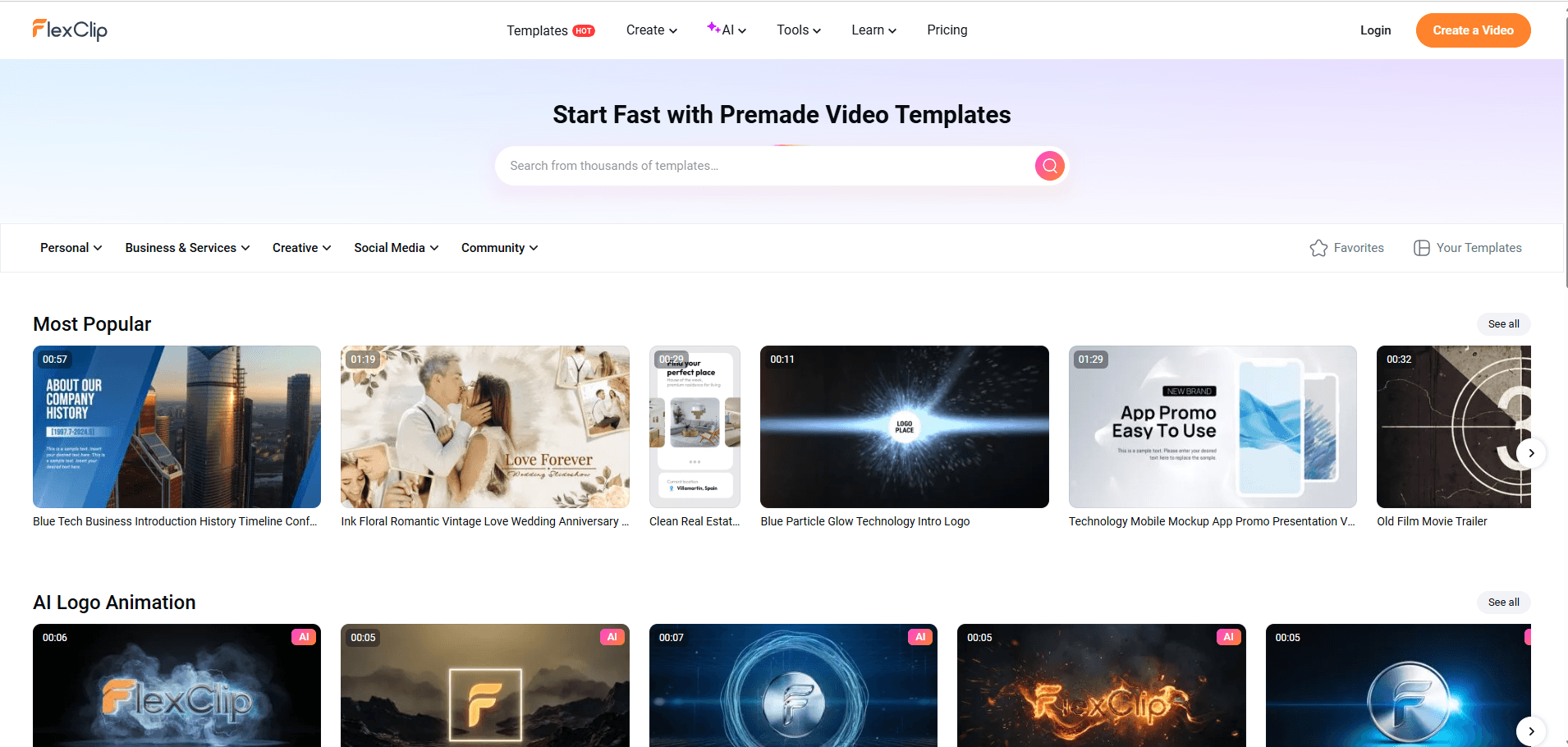
Context and role of video in B2B industrial marketing
In the context of B2B industrial marketing, content creation operates under a distinct set of constraints. Communication must be precise, structured and aligned with complex products or services, often targeting highly specialized audiences.
In this environment, video has become an increasingly relevant format, particularly for corporate websites and professional platforms such as LinkedIn. Tools that support clarity, consistency and efficiency are therefore critical. Among them, FlexClip has established itself as a practical solution within day-to-day production workflows.
A platform structured for video storytelling
Unlike more generalist design platforms, FlexClip is structured around the logic of video creation. This orientation allows it to address a recurring challenge in industrial marketing: translating technical or abstract concepts into accessible visual narratives.
Rather than prioritizing visual experimentation, the platform supports structured storytelling through scenes, timelines and modular elements that facilitate communication.
Usability and accessibility in professional environments
One of the most relevant aspects of FlexClip in this context is its ease of use. In professional environments, usability is not simply a matter of convenience; it directly impacts productivity and output quality.
The platform’s browser-based architecture removes traditional barriers associated with video editing, such as installation processes, hardware requirements or steep learning curves. This accessibility enables different profiles within a marketing team—designers, strategists or account managers—to engage with the tool without extensive technical training.
Workflow efficiency and rapid iteration
The interface is designed to support a clear and efficient workflow. The timeline structure, combined with drag-and-drop functionality and accessible editing tools, allows for rapid iteration.
Adjustments to sequences, text overlays or visual assets can be implemented quickly, which is particularly valuable in environments where feedback cycles are frequent and time-sensitive. As a result, production timelines can be shortened without compromising the clarity or consistency of the final output.
Scalability and reusable content systems
Scalability is another key factor in industrial marketing workflows. Content is rarely produced as a single isolated asset. A product launch or campaign typically requires multiple video formats adapted to different channels, audiences and markets.
FlexClip addresses this need by enabling the creation of reusable structures. Templates can be developed as base compositions and then adapted across formats, reducing repetition and ensuring consistency.
Brand consistency and structured frameworks
This approach supports the development of structured content systems rather than isolated pieces. Once a visual framework has been defined—combining typography, layout, pacing and transitions—it can be applied to multiple assets.
This not only improves efficiency but also reinforces brand coherence across touchpoints. In industrial sectors, where trust and credibility are built through consistency, this aspect becomes particularly relevant.
Multichannel adaptation
FlexClip also simplifies multichannel adaptation. Video content can be reformatted into horizontal, vertical or square formats without reconstructing the entire composition.
The platform adjusts layouts and visual elements to maintain narrative integrity across formats. This flexibility allows marketing teams to distribute content effectively across websites, social media and other digital environments while maintaining a unified visual language.
Integrated resource library
Another important component is the platform’s integrated resource library. Access to stock videos, images, music and templates within the same environment streamlines the production process.
In industrial marketing, where visual communication must remain professional and aligned with brand identity, curated resources reduce the need for external sourcing and ensure a consistent level of quality.
AI utilities and multilingual content
The availability of AI-based utilities further enhances efficiency. Features such as automatic subtitles or voice generation support the creation of multilingual and accessible content.
While these tools do not replace editorial or strategic decision-making, they reduce the operational effort required to adapt content for different audiences or regions. This is particularly useful for industrial companies operating in international markets.
Collaboration and feedback workflows
Collaboration is another area where FlexClip aligns with the needs of B2B marketing teams. Projects can be shared with different levels of access, allowing stakeholders to review, comment and suggest changes directly within the platform.
This integrated feedback system reduces the need for fragmented communication and shortens approval cycles. By centralizing revisions within a single environment, the process becomes more transparent and manageable.
Brand kits and visual governance
Brand consistency is also supported through features such as brand kits. These allow teams to define and apply visual guidelines—colors, typography and logos—across all assets.
In complex projects involving multiple contributors, this reduces the risk of inconsistencies and ensures that all outputs remain aligned with the brand identity.
Scope and limitations of the platform
It is important to position FlexClip within its appropriate scope. The platform is not designed to replace advanced tools used for complex motion graphics or highly customized animation. In those scenarios, specialized software remains necessary.
However, the majority of video content in industrial marketing does not require that level of technical complexity. Instead, it demands clarity, speed and repeatability.
A balanced solution for marketing teams
Within this context, FlexClip offers a balanced solution. It provides sufficient control to produce professional-quality content while maintaining a level of simplicity that supports efficient workflows.
By focusing on the practical needs of marketing teams, the platform avoids unnecessary complexity and delivers a coherent user experience.
Strategic relevance in industrial marketing
Ultimately, the relevance of FlexClip in industrial marketing lies in its ability to support structured content production. It enables teams to move from isolated outputs to scalable systems, where each asset contributes to a broader communication strategy.
This shift is essential in environments where content must be produced consistently and aligned with long-term objectives.
Future outlook
As video continues to play a central role in B2B communication, tools that combine usability, scalability and coherence will become increasingly valuable. FlexClip positions itself within this space as a reliable and practical option for industrial marketing teams seeking to improve efficiency without compromising quality.

Politóloga con experiencia en consultoría, comunicación corporativa y gestión de proyectos públicos y privados. Especialista en estrategia, marketing digital y transformación organizativa. Centro en la innovación y la creación de narrativas que conecten tecnología, personas y organizaciones.
Schedule a 30-minute meeting
Want to know how we can generate more leads for your business in Barcelona? Leave us your email and phone number and we’ll schedule a no-obligation call to give you a personalized assessment of your current marketing strategy.
