For over two decades, SEO relied on a relatively stable set of metrics: impressions, clicks, CTR, average positions. Everything revolved around a clear logic: a user typed a query, the search engine returned a list of links, and the goal was to appear as high as possible.
That model has just definitively broken.
With the announcement of AI Performance in Bing Webmaster Tools, Bing confirms something many of us had already been detecting in data and user behavior: search no longer necessarily ends in a click. In many cases, the answer occurs within the search engine itself, mediated by generative AI models that synthesize information from multiple sources.
This change forces us to rethink how we understand visibility, performance, and the value of content. And, above all, how we measure it.
What is “AI Performance” and why does it mark a before and after
The new AI Performance section within Bing Webmaster Tools introduces a set of metrics designed specifically to measure how a site’s content participates, appears, or is cited in AI-based search experiences.
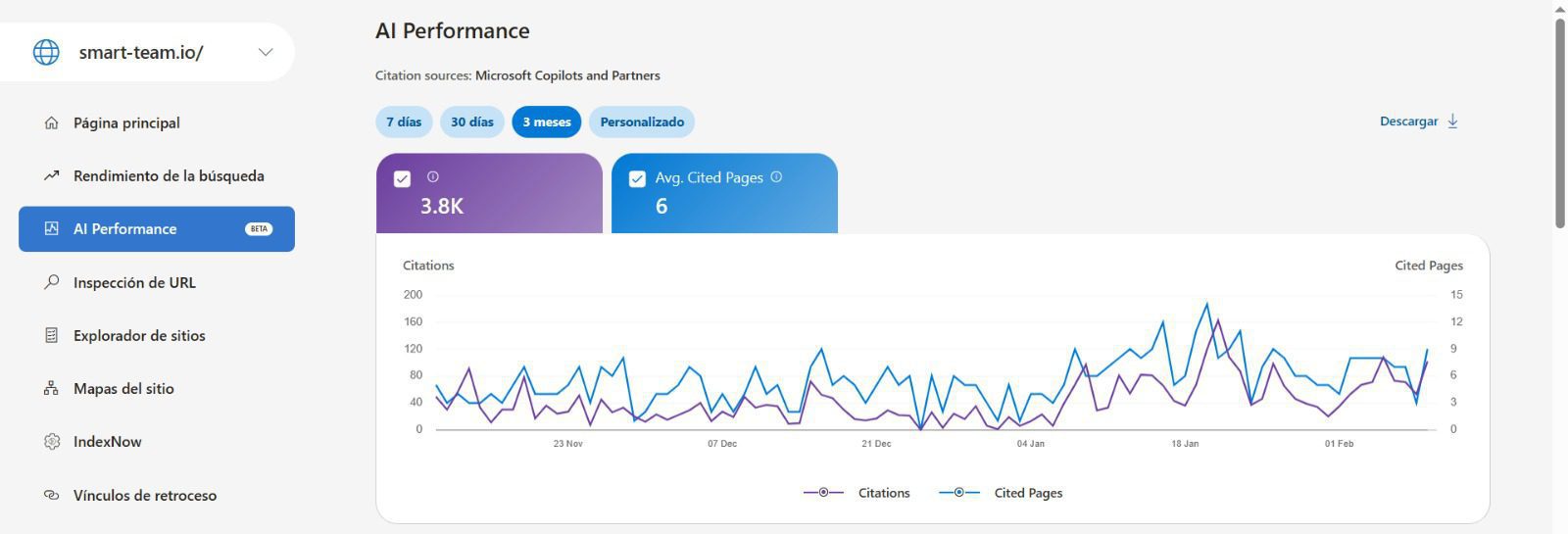
This isn’t just an aesthetic addition. It’s an explicit recognition that:
- The search engine is no longer just an intermediary to websites.
- AI acts as an interpretive, synthesizing, and problem-solving layer.
- Content can generate value even without a traditional click.
For the first time, a search engine offers partial visibility into something that until now was a “black box”:
How and when AI uses your content to build answers.
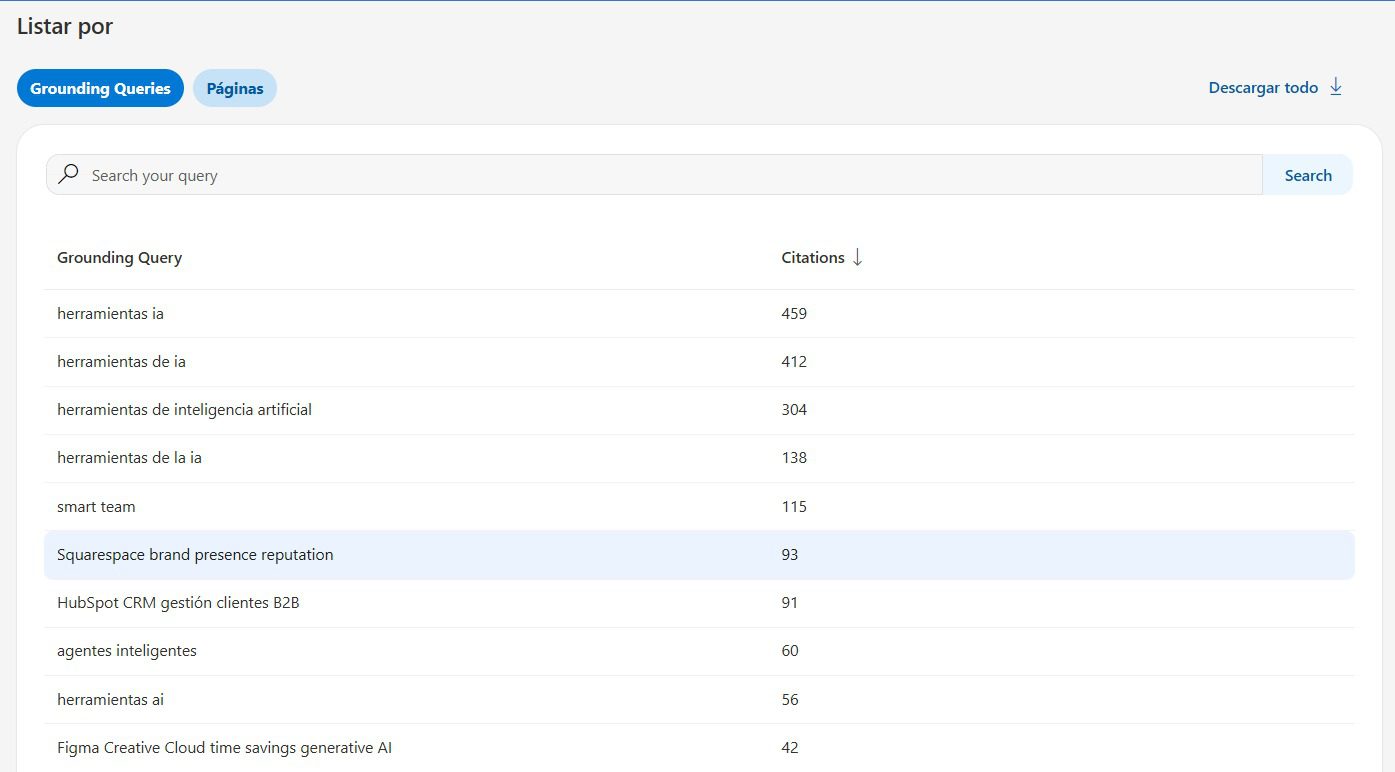
What are grounding queries?
In the context of AI-powered search, grounding queries are the queries that the model uses internally to “anchor” or ground the generated response in real sources from the search engine’s index.
That is, when an AI system builds a conversational response, it doesn’t invent from scratch: it performs additional searches—these grounding queries—to retrieve relevant documents, validate information, and reduce the risk of inaccuracies. In practical terms, they’re the bridge between the generative model and the search engine’s traditional index, and they determine which content can be cited, used, or influence the final answer.
From classic SEO to GEO for AI systems
To understand the magnitude of the change, it’s worth comparing both models.
Classic SEO
- Main metric: click
- Objective: traffic
- Unit of success: session
- Strategy: position URLs
SEO in AI environments
- Main metric: presence / contribution
- Objective: influence + authority
- Unit of success: mention, citation, use as source
- Strategy: position knowledge
AI Performance was born to measure this second model.
What metrics does AI Performance introduce
Although Bing is careful with the level of detail (for obvious intellectual property and model security reasons), the tool introduces new layers of key information:
3.1 Appearances in AI-generated responses
Indicates how many times your site’s content was used as a direct or indirect reference in an AI response.
This doesn’t necessarily imply a visible link, but it does mean a real semantic contribution.
3.2 Impressions in AI search experiences
These aren’t classic impressions. They reflect content exposure within a conversational flow, summary, or AI-generated block.
3.3 Subsequent interactions
In some cases, the user decides to dig deeper, ask for sources, or visit the site. AI Performance allows you to understand which content generates that “jump”.
3.4 Trends and evolution
The tool allows analyzing the temporal evolution of these metrics, something fundamental for validating whether a content strategy is being understood by AI models.
Why Bing is ahead (again)
It’s no coincidence that this move comes from Bing.
Microsoft has been integrating generative AI into its search, productivity, and data ecosystem for some time. Bing already functions as a testing ground for many behaviors that later expand to other environments.
AI Performance fulfills three clear objectives for Microsoft:
- Educate the market about the new search model
- Give early signals to creators and companies
- Attract technical and strategic profiles who want to understand the new value layer
The real impact for B2B and industrial companies
This change doesn’t affect everyone equally.
In fast-moving B2C consumer sectors, AI can resolve many queries without needing to dig deeper. But in industrial, technical, and B2B environments, the opposite happens:
- Decisions are complex
- Purchase cycles are long
- The user needs context, methodology, and expert judgment
This makes well-crafted technical content have much more weight as an AI source.
Clear examples:
- Technical guides
- Process documentation
- Methodological comparisons
- Diagnostic articles
- Case studies with real data
This type of content is pure gold for AI models… if it’s well structured.
What changes in content strategy
AI Performance isn’t just a new metric. It’s a strategic signal.
6.1 From “posts” to “knowledge pieces”
AI doesn’t value content by frequency, but by information density, conceptual clarity, and internal coherence.
6.2 From keywords to entities and relationships
Models work with concepts, not text strings. This requires:
- Defining entities well
- Explaining relationships
- Contextualizing decisions
6.3 From traffic to influence
An article that doesn’t generate clicks but is cited by AI in multiple responses can have more indirect commercial impact than one with superficial traffic.
How to optimize content for AI Performance
Based on what Bing reveals (and how language models work), there are several clear best practices:
7.1 Structural clarity
- Descriptive titles
- Subheadings that answer real questions
- Lists, steps, conceptual tables
7.2 Real depth
AI quickly detects superficial content. Texts that work best usually:
- Explain the “why”
- Show trade-offs
- Include decision criteria
7.3 Thematic consistency
A site that works a topic well over time has a higher chance of being considered a trusted source.
7.4 Authorship and context
Signing content, explaining experience, showing real cases. All of this helps the model “understand” where the knowledge comes from.
AI Performance and the redefinition of content ROI
One of the biggest challenges this model introduces is how to measure return.
Until now:
- Content = visits
- Visits = leads
Now:
- Content = influence
- Influence = trust
- Trust = commercial conversations
AI Performance doesn’t replace other metrics, but adds a layer that didn’t exist before.
The risk of not adapting
Companies that continue measuring only traffic will make two serious mistakes:
- Underestimate the real impact of their content
- Abandon pieces that are actually working as AI sources
The result: less future visibility, less authority, and lower presence in complex decisions.
What we’ll probably see next
AI Performance is in public preview, but it’s easy to anticipate next steps:
- Greater granularity by content type
- Relationship between entities and sectors
- Integration with conversion data
- Competitive comparisons in AI environments
And, probably, similar moves in other search engines.
What marketing and SEO teams should do today
Clear and actionable recommendations:
- Audit existing content with an “AI-first” mindset
- Identify pieces that explain processes, not just concepts
- Strengthen structure and semantic clarity
- Measure beyond the click
- Understand that visibility is no longer binary
AI Performance isn’t just another metric, it’s a mindset shift
AI Performance isn’t an isolated functionality. It’s official confirmation that search has changed in nature. We no longer compete only for positions.
We compete to be understood, cited, and used by AI systems that mediate the relationship between brands and people.
Companies that understand this first will build an advantage that’s difficult to replicate.
Those that don’t will continue looking at metrics that no longer explain reality.
At Smart Team we don’t start from zero: we build from years of experience in industrial SEO and combine it with a deep understanding of how AI interprets content today. Request an initial GEO audit

Consultor SEO con más de 15 años de experiencia en Marketing, optimización web y estrategias digitales. Ayudo a negocios locales, pymes y grandes empresas a mejorar su posicionamiento online, alcanzar sus objetivos de crecimiento y adaptarse a un mundo digital cada día más competitivo.
Schedule a 30-minute meeting
Want to know how we can generate more leads for your business in Barcelona?
Leave us your email and phone number and we’ll schedule a no-obligation call to give you a personalized assessment of your current marketing strategy.