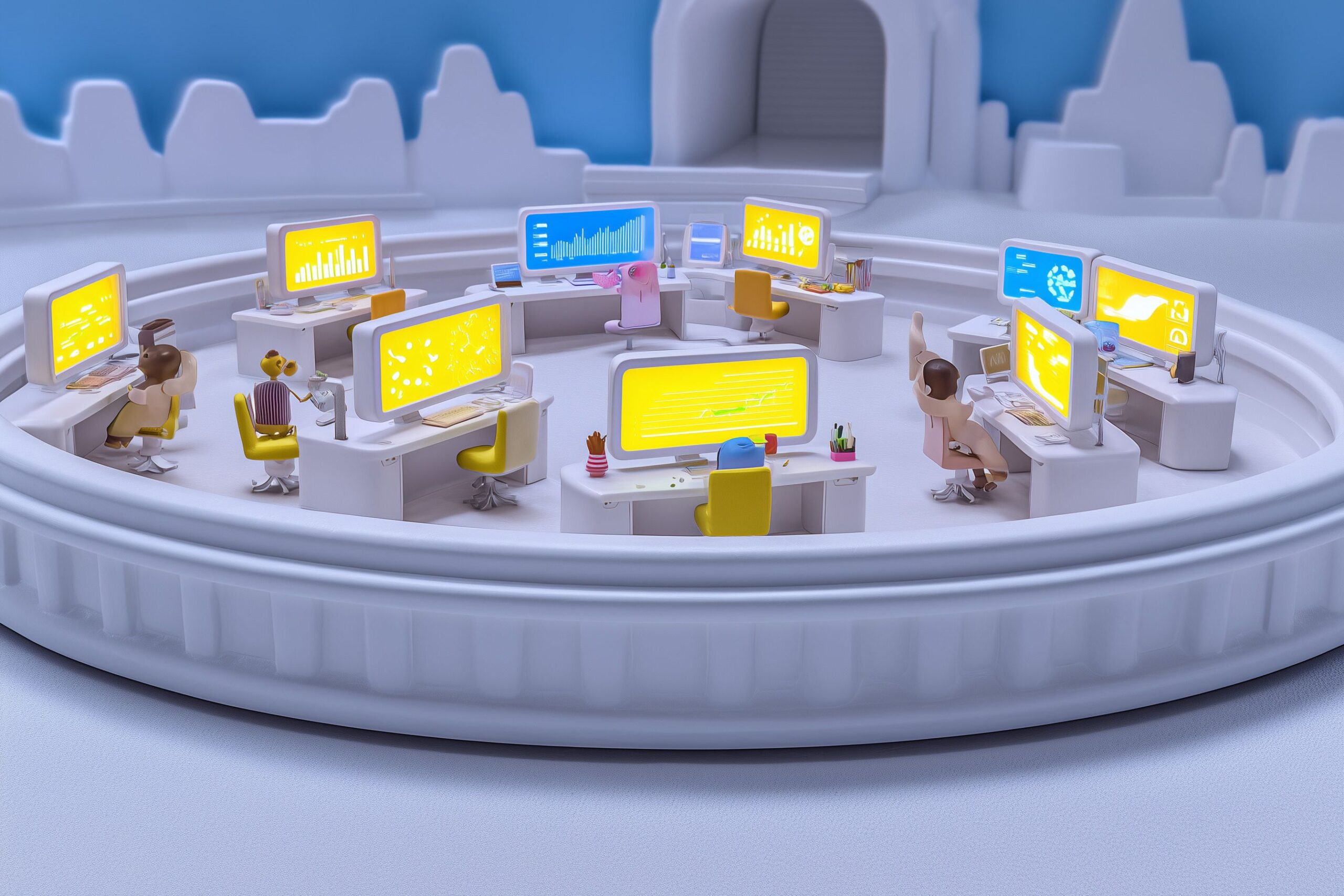
Whether we like to admit it or not, we live trapped by a strange inertia. We observe perplexed at the advances in artificial intelligence, the news reaching us from the global geopolitical landscape, the new and rather horrifying ways of consuming information, or the rising cost of living, but at the same time it feels like nothing truly changes. We continue organizing our domestic logistics, the economy, work, and even public life based on ideas we know to be obsolete, with an increasingly fragile faith in the narratives that sustain them. We keep doing the same things as always, even though we have enough evidence to clearly see that many things are breaking and that quite a few of these may no longer be fixable.
“Hypernormality” is a term coined by Russian anthropologist Alexei Yurchak to describe the final years of the USSR: an era when Russian society was generally aware that the system no longer worked properly, but everyone pretended otherwise because it was easier to maintain the fiction than to face the uncertainty of collapse. British filmmaker Adam Curtis revisited the concept in 2016 in his documentary HyperNormalisation to bring it to bear on a critical judgment of contemporary liberal democracies. We live under structures maintained more by inertia than by conviction, in an environment where the narrative of reality has been replaced by more or less functional communicative substitutes.
This is the state of things regarding many of the major events happening around us. The explosion of applied artificial intelligence is no minor element of our current context and is destined to transform the world we’ve known into something we still don’t know how to explain and that we also don’t know if we’ll like too much when it reaches a state of maturity.
What cannot be simulated
Vallès is a territory historically linked to manufacturing production. The great narratives of digital modernization haven’t been forged here, but industry has been done with rigor, drive, and with a temporal continuity that we hope will be maintained for many years. Innovation in the region has always been functional and generally from the workshop, from the industrial warehouse and the industrial park. From advances carried out by people rather dressed in blue work overalls or white lab coats than in suits and ties.
The city of Terrassa is known for its long textile tradition and has been a center of innovation in dyeing and spinning machinery. Local companies developed equipment that significantly improved fabric production, allowing for greater efficiency and increased quality of final products. Even today, the Textile Research and Industrial Cooperation Institute of Terrassa (INTEXTER) has pilot plants for complete dyeing and finishing processes, contributing to research and continuous improvement of textile sector production techniques. And even today there are important auxiliary industries for that sector, although it has had a highly diversified production structure for decades.
The first mechanical looms arrived in Sabadell in 1864, paving the way for massive industrialization of the region. By 1876 the city was already successfully producing its first mechanical wool looms, and they weren’t just supplied locally—they were exported to many European countries starting from the Barcelona Universal Exhibition of 1888. From the mid-20th century onward, the city also experienced notable development in the manufacture of automatic lathes, advances driven by the need to improve efficiency in the production of metal parts to meet demand from various sectors such as textiles and automotive.
In Granollers, the Roca Umbert factory (which today houses a cutting-edge and enviable cultural space) integrated the entire textile production process on a single site, from spinning to dyeing, and even had its own thermal plant to guarantee autonomous supply for the entire factory. Meanwhile, Mollet del Vallès didn’t remain foreign to the textile industry, but above all managed to put itself on the global industrial map thanks to its motorcycles. From this area of the region came the legendary Derbi motorcycles, winners of 12 world riders’ titles and 9 constructors’ titles, a brand that became a global reference in speed motorcycling, especially in small displacements and standing out for a high level of technical innovation. The city and its nearby towns were a hugely important hub for auxiliary industry, manufacturing components for many European motorcycle brands.
The region, Vallès, has also remained an important logistics center thanks in large part to its strategic location. Much water has passed under the bridge since the start of the industrial revolution, many economic crises have been overcome, and the balance of all this time that has elapsed is certainly complex and also varied, but it’s worth noting that the region contributes approximately 17.12% of Catalonia’s GDP, of which 30.67% of gross value added can be attributed to industry.
Industry as the center of gravity
Not only the most classic manufacturing industry, but also agriculture and in general all those activities that require people who get up every day to generate physical products. In a world digitalizing at a frenetic pace, that which is anchored in physical reality has an added value that algorithms and data centers cannot replicate. At least for now. The physical is profoundly real. It’s produced, transported, assembled, and maintained. It demands raw materials, time, knowledge, energy, and precision. That’s why, faced with the temptation to feel overwhelmed after the latest feat of our trusted LLM, we must remember that the tangible world is still here with us, and in that reflection we can find some peace and calm.
While the narrative of artificial intelligence occupies the vast majority of conversations, there’s another reality that persists at the margins of discourse and to which we should all pay more attention. It’s that economy, which seems secondary when everything is going well but will always be essential for any country and will be even more so if things start to go truly wrong.
The need to communicate and give visibility to industry
There’s something industry still hasn’t resolved well. For decades, many companies have survived and prospered without needing to explain themselves or seek public notoriety. Typically, companies of this type haven’t sought visibility, and sometimes significant efforts must be made to find out what productive activities are carried out in places you pass by every day and who carries them out. It’s not that industry needs to reinvent itself, it needs to be recognized, and to achieve that it needs to communicate much better.
Without explaining how the real economy works, the communicative void will be filled by others with narratives of digital promises without anchor, multimillion-dollar financing rounds for cash-incinerating companies, innovation speeches that ignore the country’s productive base, and more or less utopian (or dystopian, depending on the angle from which they’re observed) rhetoric of modernity, but with the capacity to attract a lot of media attention to themselves.
This problem isn’t fixed only with B2B communication, which is where these types of companies invest the most. Public relations are also necessary, fluid and constant dialogue with the press, visibility work on social media, and in general, an effort must be made to communicate that industry is fortunately a living reality. It has traditionally been a generator of development and must once again become the center of economic policies. Much narrative is needed, and also self-esteem.
The future cannot be built solely from data and software. Countries don’t float in the air. They rest on production chains, tools, technical talent, logistics environments, manufacturing, cooperatives, workshops, warehouses, laboratories, proximity, trains, excavators, tractors, materials, industrial parks, and a dense fabric of companies that don’t stop their activities any of the 24 hours of the day. We need to think much more about the tangible economy and how it positively affects societies. Not out of nostalgia, but out of common sense.

Emprendedor y profesional con experiencia en sectores como las agencias digitales, la comunicación corporativa, la industria musical y las administraciones públicas. Especialista en organizaciones y desarrollo de negocio. Enfocado en la comprensión y el uso de las tecnologías digitales.
Schedule a 30-minute meeting
Want to know how we can generate more leads for your business in Barcelona?
Leave us your email and phone number and we’ll schedule a no-obligation call to give you a personalized assessment of your current marketing strategy.