
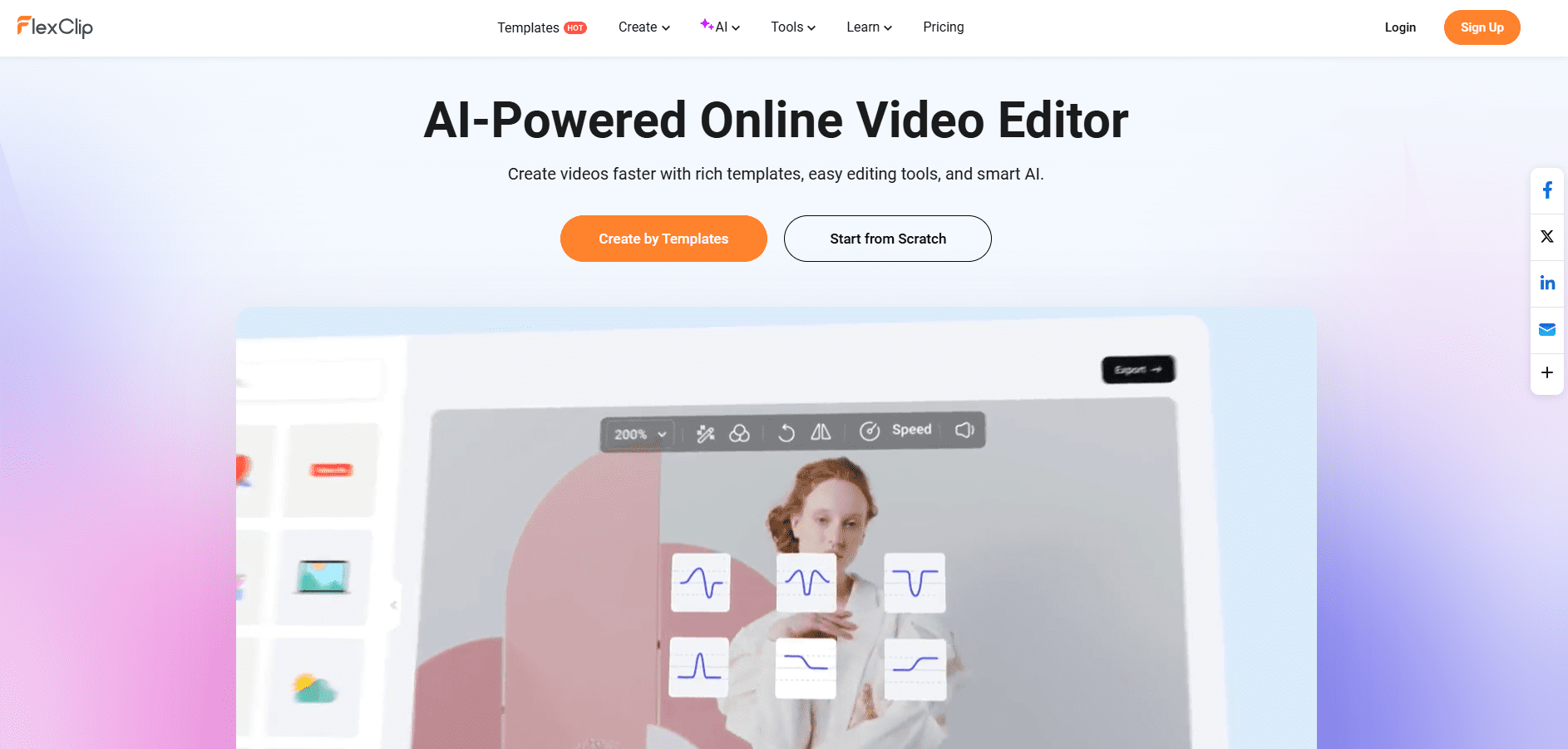
In the context of a B2B marketing agency, tools rarely stand out because of novelty. They stand out because they quietly solve problems, reduce friction, and allow teams to operate at scale without compromising quality. Over the past two years, FlexClip has become one of those tools in our day‑to‑day workflow. Not as a disruptive replacement for everything else, but as a reliable environment where a significant part of our audiovisual content is produced. For teams looking to understand how it fits into real‑world production, FlexClip’s overview of use cases and capabilities is a good starting point: FlexClip for Marketing Teams.
What I value most is not any single feature, but the coherence of the platform as a whole. FlexClip seems designed with a clear understanding of how marketing teams actually work: multiple stakeholders, limited time, recurring formats, and a constant need to deliver polished content. In that sense, it fits naturally into a B2B agency environment where efficiency is not a preference, but a requirement. The platform’s interface and structure are explained in detail here, which gives a sense of how you can deploy it across different stages of content creation.
Ease of use as an operational advantage
Ease of use is often described as a superficial benefit, but in practice it has a direct impact on productivity and team dynamics. In our case, FlexClip’s browser‑based structure eliminates many of the traditional barriers associated with video editing. There is no installation process, no dependency on specific hardware, and no steep learning curve. This is made possible by the way the platform is built and hosted, which also explains how teams can start working immediately without provisioning or configuration: FlexClip Online Video Editor.
This has practical consequences. A new team member can start working on a project almost immediately. An account manager can make small adjustments without relying on a specialist. A strategist can quickly prototype an idea without disrupting the creative team. The interface itself is structured in a way that supports this fluidity, with a clear timeline and accessible editing tools that do not require deep technical knowledge. When feedback comes in—and in B2B it always does—the ability to implement changes quickly becomes a competitive advantage. Adjusting timing, updating text, or replacing assets can be done in minutes, allowing us to keep projects moving without unnecessary delays.
Scalability beyond individual assets
If creating a single piece of content is relatively straightforward, maintaining a consistent output over time is considerably more complex. This is where FlexClip proves particularly valuable. It allows us to move from isolated production to structured content systems. By leveraging templates and reusable structures, agencies can build a scalable content engine that adapts to multiple clients and channels while staying aligned with brand guidelines.
In practical terms, this means working with reusable templates that reflect specific content types: product explainers, campaign snippets, client stories. Once these structures are defined, they can be adapted across different clients, markets, and formats without starting from scratch. This approach reduces both production time and cognitive load, enabling the team to focus on messaging rather than mechanics. In one recent campaign cycle, we managed the production of more than a hundred video assets across multiple accounts. The only way this was possible with a relatively small team was by relying on repeatable structures. FlexClip supports this logic naturally, without forcing complex setups or additional tools.
It also simplifies multichannel adaptation. The same piece of content can be reformatted for different platforms—horizontal, vertical, square—without rebuilding the entire composition. This flexibility is essential in B2B marketing, where consistency across channels reinforces brand perception and helps messaging cut through fragmented attention.
Resources that support execution, not distraction
Another aspect that often goes unnoticed is the role of built‑in resources. Many platforms offer extensive libraries, but not all of them are equally useful in a professional context. FlexClip strikes a balance that I find particularly effective. Its templates are clearly oriented toward real marketing use cases. They are not overly decorative or experimental, but structured in a way that supports clear communication. This is important in B2B, where the objective is not to impress with design, but to convey information with precision and credibility.
The stock library follows a similar logic. Video clips, images, and music tracks are curated with practical application in mind. This reduces the time spent searching for suitable assets and ensures a consistent level of quality across projects. Instead of relying on external sources or managing licensing separately, the team can work within a single environment. The platform’s stock section gives a clear sense of the breadth and tone of available assets, which is useful for teams that need to maintain a serious but professional visual language: FlexClip Stock Media.
The inclusion of AI‑based utilities adds another layer of efficiency. Features such as automatic subtitles or synthetic voiceovers are not revolutionary in themselves, but they are well integrated and easy to use. They allow us to produce multilingual or accessible content without significantly increasing production time. These tools also help us respond to client requirements around inclusivity and global reach, without turning each adaptation into a new project.
Utilities aligned with real workflows
What ultimately defines the usefulness of a tool is how well it integrates into existing workflows. In this regard, FlexClip aligns closely with the operational realities of a B2B agency. Collaboration is one of its strongest points. Projects can be shared with different levels of access, allowing clients and team members to review, comment, and suggest changes directly within the platform. This reduces the need for fragmented communication and shortens approval cycles. Instead of exchanging files and emails, feedback becomes part of the project itself.
Brand consistency is also easier to maintain. The use of brand kits ensures that colors, fonts, and visual elements remain aligned across all assets. This is particularly relevant when multiple people are involved in production, as it minimizes the risk of inconsistencies. From a distribution perspective, the platform connects smoothly with common storage solutions, making it easy to transfer assets to other parts of the marketing stack. While it does not aim to replace more complex systems, it integrates well enough to support a coherent workflow from creation to publication.
Measurable impact in daily operations
The value of FlexClip becomes most evident when looking at outcomes rather than features. In our experience, production times have decreased significantly, in some cases by nearly half for standard video assets. This is not due to a single factor, but to the cumulative effect of ease of use, reusable structures, and integrated resources. The platform’s templates and workflow design help teams move quickly from concept to export, which is especially valuable in time‑constrained campaigns.
Collaboration has also improved. Feedback loops are shorter, revisions are clearer, and the overall process is more transparent. This has a direct impact on both client satisfaction and internal efficiency. Teams spend less time managing the process and more time refining the content itself. Quality and consistency have followed the same trajectory. By working within structured templates and curated resources, we ensure that outputs meet a certain standard without requiring excessive effort. This is particularly important in B2B environments, where trust is built through clarity and coherence over time.
A balanced perspective
It would be unrealistic to present FlexClip as a universal solution. For complex productions, advanced motion graphics, or highly customized visual work, more specialized tools remain necessary. FlexClip does not aim to replace those environments, and in our case, it coexists with them. However, this limitation is also part of its strength. By focusing on a specific segment of content production—the kind that represents the majority of day‑to‑day marketing work—it avoids unnecessary complexity and delivers a more efficient experience.
To summarize, using FlexClip has reinforced a simple but important idea: the most valuable tools are not the most powerful, but the most usable in real conditions. In a B2B marketing agency, where content must be produced consistently and at scale, this distinction becomes critical. FlexClip does not try to do everything, and that is precisely why it works. It provides a clear, reliable environment for creating video content that meets professional standards without slowing down the process. It allows teams to focus on what truly matters: the message, the structure, and the value delivered to the client.
Listen to it now


Politóloga con experiencia en consultoría, comunicación corporativa y dirección de proyectos públicos y privados. Especialista en estrategia, marketing digital y transformación organizativa. Enfocada en la innovación y en la creación de narrativas que conectan tecnologías, personas y organizaciones.
In the context of a B2B marketing agency, tools rarely stand out because of novelty. They stand out because they quietly solve problems, reduce friction, and allow teams to operate at scale without compromising quality. Over the past two years, FlexClip has become one of those tools in our day‑to‑day workflow. Not as a disruptive replacement for everything else, but as a reliable environment where a significant part of our audiovisual content is produced. For teams looking to understand how it fits into real‑world production, FlexClip’s overview of use cases and capabilities is a good starting point: FlexClip for Marketing Teams.
What I value most is not any single feature, but the coherence of the platform as a whole. FlexClip seems designed with a clear understanding of how marketing teams actually work: multiple stakeholders, limited time, recurring formats, and a constant need to deliver polished content. In that sense, it fits naturally into a B2B agency environment where efficiency is not a preference, but a requirement. The platform’s interface and structure are explained in detail here, which gives a sense of how you can deploy it across different stages of content creation.
Ease of use as an operational advantage
Ease of use is often described as a superficial benefit, but in practice it has a direct impact on productivity and team dynamics. In our case, FlexClip’s browser‑based structure eliminates many of the traditional barriers associated with video editing. There is no installation process, no dependency on specific hardware, and no steep learning curve. This is made possible by the way the platform is built and hosted, which also explains how teams can start working immediately without provisioning or configuration: FlexClip Online Video Editor.
This has practical consequences. A new team member can start working on a project almost immediately. An account manager can make small adjustments without relying on a specialist. A strategist can quickly prototype an idea without disrupting the creative team. The interface itself is structured in a way that supports this fluidity, with a clear timeline and accessible editing tools that do not require deep technical knowledge. When feedback comes in—and in B2B it always does—the ability to implement changes quickly becomes a competitive advantage. Adjusting timing, updating text, or replacing assets can be done in minutes, allowing us to keep projects moving without unnecessary delays.
Scalability beyond individual assets
If creating a single piece of content is relatively straightforward, maintaining a consistent output over time is considerably more complex. This is where FlexClip proves particularly valuable. It allows us to move from isolated production to structured content systems. By leveraging templates and reusable structures, agencies can build a scalable content engine that adapts to multiple clients and channels while staying aligned with brand guidelines.
In practical terms, this means working with reusable templates that reflect specific content types: product explainers, campaign snippets, client stories. Once these structures are defined, they can be adapted across different clients, markets, and formats without starting from scratch. This approach reduces both production time and cognitive load, enabling the team to focus on messaging rather than mechanics. In one recent campaign cycle, we managed the production of more than a hundred video assets across multiple accounts. The only way this was possible with a relatively small team was by relying on repeatable structures. FlexClip supports this logic naturally, without forcing complex setups or additional tools.
It also simplifies multichannel adaptation. The same piece of content can be reformatted for different platforms—horizontal, vertical, square—without rebuilding the entire composition. This flexibility is essential in B2B marketing, where consistency across channels reinforces brand perception and helps messaging cut through fragmented attention.
Resources that support execution, not distraction
Another aspect that often goes unnoticed is the role of built‑in resources. Many platforms offer extensive libraries, but not all of them are equally useful in a professional context. FlexClip strikes a balance that I find particularly effective. Its templates are clearly oriented toward real marketing use cases. They are not overly decorative or experimental, but structured in a way that supports clear communication. This is important in B2B, where the objective is not to impress with design, but to convey information with precision and credibility.
The stock library follows a similar logic. Video clips, images, and music tracks are curated with practical application in mind. This reduces the time spent searching for suitable assets and ensures a consistent level of quality across projects. Instead of relying on external sources or managing licensing separately, the team can work within a single environment. The platform’s stock section gives a clear sense of the breadth and tone of available assets, which is useful for teams that need to maintain a serious but professional visual language: FlexClip Stock Media.
The inclusion of AI‑based utilities adds another layer of efficiency. Features such as automatic subtitles or synthetic voiceovers are not revolutionary in themselves, but they are well integrated and easy to use. They allow us to produce multilingual or accessible content without significantly increasing production time. These tools also help us respond to client requirements around inclusivity and global reach, without turning each adaptation into a new project.
Utilities aligned with real workflows
What ultimately defines the usefulness of a tool is how well it integrates into existing workflows. In this regard, FlexClip aligns closely with the operational realities of a B2B agency. Collaboration is one of its strongest points. Projects can be shared with different levels of access, allowing clients and team members to review, comment, and suggest changes directly within the platform. This reduces the need for fragmented communication and shortens approval cycles. Instead of exchanging files and emails, feedback becomes part of the project itself.
Brand consistency is also easier to maintain. The use of brand kits ensures that colors, fonts, and visual elements remain aligned across all assets. This is particularly relevant when multiple people are involved in production, as it minimizes the risk of inconsistencies. From a distribution perspective, the platform connects smoothly with common storage solutions, making it easy to transfer assets to other parts of the marketing stack. While it does not aim to replace more complex systems, it integrates well enough to support a coherent workflow from creation to publication.
Measurable impact in daily operations
The value of FlexClip becomes most evident when looking at outcomes rather than features. In our experience, production times have decreased significantly, in some cases by nearly half for standard video assets. This is not due to a single factor, but to the cumulative effect of ease of use, reusable structures, and integrated resources. The platform’s templates and workflow design help teams move quickly from concept to export, which is especially valuable in time‑constrained campaigns.
Collaboration has also improved. Feedback loops are shorter, revisions are clearer, and the overall process is more transparent. This has a direct impact on both client satisfaction and internal efficiency. Teams spend less time managing the process and more time refining the content itself. Quality and consistency have followed the same trajectory. By working within structured templates and curated resources, we ensure that outputs meet a certain standard without requiring excessive effort. This is particularly important in B2B environments, where trust is built through clarity and coherence over time.
A balanced perspective
It would be unrealistic to present FlexClip as a universal solution. For complex productions, advanced motion graphics, or highly customized visual work, more specialized tools remain necessary. FlexClip does not aim to replace those environments, and in our case, it coexists with them. However, this limitation is also part of its strength. By focusing on a specific segment of content production—the kind that represents the majority of day‑to‑day marketing work—it avoids unnecessary complexity and delivers a more efficient experience.
To summarize, using FlexClip has reinforced a simple but important idea: the most valuable tools are not the most powerful, but the most usable in real conditions. In a B2B marketing agency, where content must be produced consistently and at scale, this distinction becomes critical. FlexClip does not try to do everything, and that is precisely why it works. It provides a clear, reliable environment for creating video content that meets professional standards without slowing down the process. It allows teams to focus on what truly matters: the message, the structure, and the value delivered to the client.
Listen to it now
Politóloga con experiencia en consultoría, comunicación corporativa y dirección de proyectos públicos y privados. Especialista en estrategia, marketing digital y transformación organizativa. Enfocada en la innovación y en la creación de narrativas que conectan tecnologías, personas y organizaciones.
