The news that changes the rules of who can use Search Console
For more than a decade, Google Search Console was exclusive to people who had their own website: you needed control over a domain or a URL prefix in order to verify a property and access search performance data. That logic has just been broken.
Google has introduced platform properties, a new property type in Search Console designed to help website owners and creators understand how their social and video posts perform in Google Search and Discover. The announcement arrived on July 7, 2026 through the official Google Search Central blog, signed by Moshe Samet, Product Manager Lead for Search Console.
The implication is direct: for the first time, Search Console lets users connect a social media account for which they do not have developer access and see the search data behind it. That is genuinely new territory for the tool.
What Platform Properties actually are
The best way to understand Platform Properties is to contrast them with what existed before. Until now, Search Console recognized two property types: the full domain and the URL prefix, both tied to a website that you had to control technically.
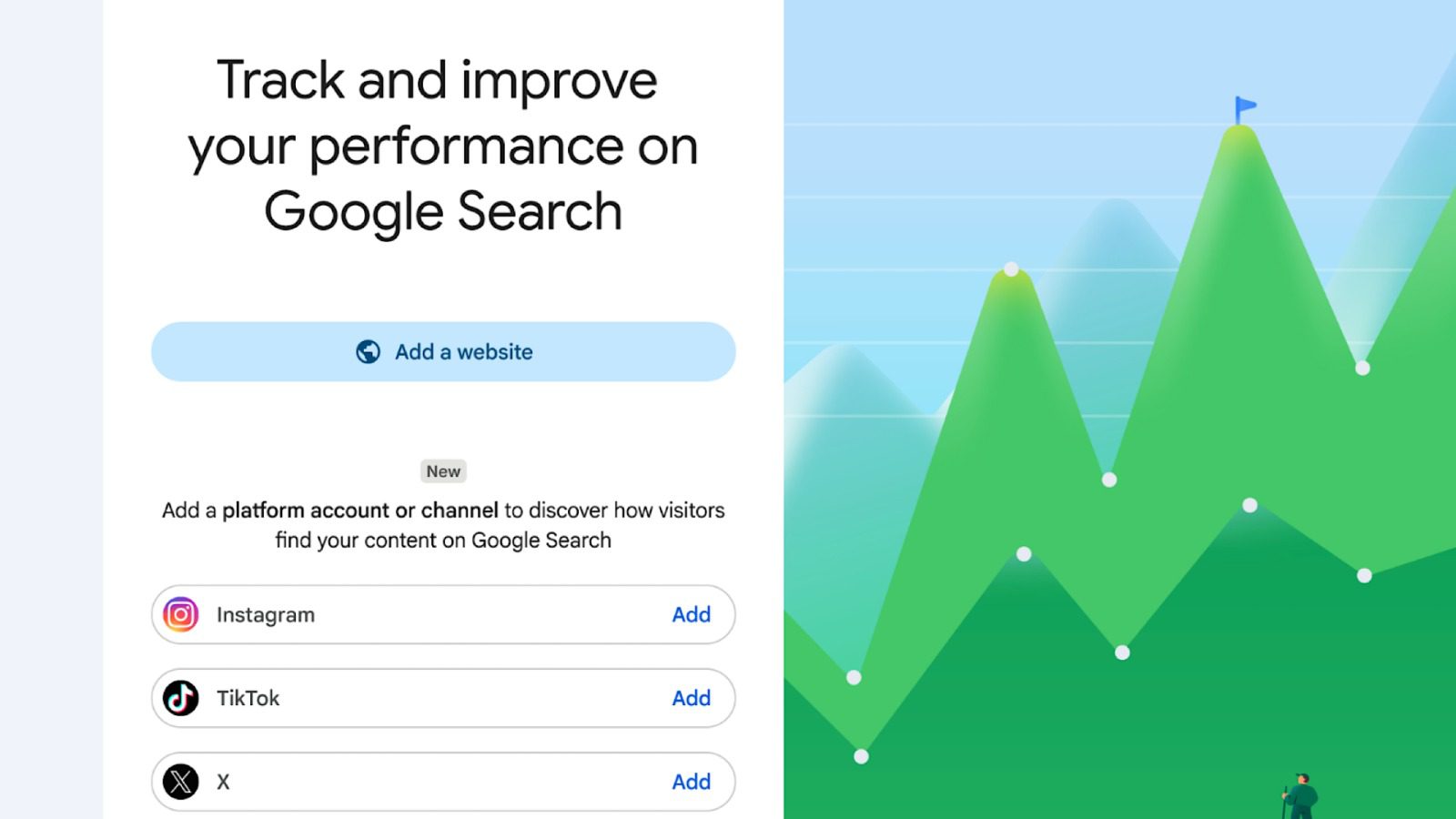
Platform Properties are a new property type inside Search Console. Following a previous experiment launched in December 2025, this feature is now rolling out more broadly. It allows creators who do not have their own website to connect an Instagram, TikTok, X, or YouTube account and see how the content from that account performs in Google Search and Discover.
In practice, that means a content creator who operates exclusively through a YouTube channel or an Instagram profile can now access data that used to be invisible: which search terms bring users to the content, how many impressions and clicks that content generates from Google, and how that performance evolves over time.
Creators can now see the number of impressions, clicks, and average ranking positions for specific search queries that lead users directly to a YouTube video or a TikTok page. It is an effort to unify information that was previously scattered and difficult to access.
The three reports available
Once a platform is connected, the data is integrated into three sections of the Search Console ecosystem:
Performance report. It shows total clicks, impressions, and other related metrics, with the ability to filter and sort to identify which posts and queries generate the most traffic. The data can be exported for analysis in other tools.
Insights report. It offers a high-level overview of recent traffic trends, the best-performing posts, and how users discover the account on Google.
Achievements. It monitors progress toward milestones, such as surpassing a new total click threshold from Search within a 28-day period.
These three reports reproduce the same logic SEOs already know from traditional website properties, but applied to social and video content. This is not a parallel interface: it is the same Search Console reporting architecture, extended to new surfaces.
How to set it up: the verification process
To access the feature, users must add a new property in Search Console, select one of the four supported platforms, and complete the verification process to authorize the connection.
The concrete flow is: open Search Console, go to the property selector, choose “Add property,” select Instagram, TikTok, X, or YouTube, and follow the on-screen steps to authorize the account. The connection is completed through Google’s official verification flow. Authorization is finalized through on-screen confirmation steps that securely verify ownership of the account before any data is shared.
One relevant detail for anyone wanting to implement it today: platform properties will become available gradually over the coming weeks, so the option may not yet be visible in your account.
Platform Properties vs. Search Profiles: do not confuse them
The announcement arrives at a moment when Google has launched several updates related to creator presence in Search, and it is easy to mix them up. It is worth clarifying the difference.
Platform properties are different from Search profiles, which Google introduced in June as public profile pages for qualified creators and publishers. A Search profile is a shareable page that consolidates a creator’s content for followers. By contrast, a platform property focuses on analytics, showing how those posts perform in Search rather than exposing them directly to an audience.
Put differently: the Search Profile is your storefront on Google; the Platform Property is your internal data dashboard. They are complementary, not interchangeable.
Barry Schwartz, founder of Search Engine Roundtable and news editor at Search Engine Land, added another relevant nuance about the history of the feature: Google already had something similar in 2025, called Social Channels inside Search Console Insights. This should not be confused with the new Search Profiles or the new Search Profile Insights. What is especially notable now is that users can verify properties on domain names they neither own nor develop.
Why Google is doing this now: the strategic context
The launch of Platform Properties is not an isolated technical improvement. It is a response to a shift in how content discovery works in 2026, and to the competitive pressure Google has accumulated from vertical video platforms.
In recent years, Google has faced strong competition from platforms like TikTok, which younger generations increasingly use as an alternative search engine. By giving creators better tools to understand the value of Google as a traffic source, the company is trying to maintain its dominance as the internet’s central hub.
The strategic implication is clear: Google recognizes that owning a website is no longer the only relevant digital presence point. Google is signaling that its visibility matters regardless of where the content lives, and it wants both site owners and creators to understand that their off-site assets also generate signals inside the search ecosystem.
That has direct consequences for B2B content strategy. An industrial company publishing use cases on LinkedIn, process tutorials on YouTube, or material comparisons in short videos previously had no native way to know how much traffic Google was sending to those publications. Platform Properties changes that equation.
The implication for GEO strategy and social SEO
From the perspective of visibility in generative AI engines, this Google move has an additional dimension worth analyzing.
The same kind of social content Google now lets users monitor in Search Console —YouTube videos with transcripts, posts with technical context on Instagram, explanatory threads on X— is also the kind of content AI models process to build their answers.
The correlation between organic performance in Google and the probability of citation in generative AI engines that has been documented in other articles also applies here: if a YouTube video performs well in Google organic search, it is more likely to be cited by Gemini, ChatGPT, or Perplexity when a user asks about that topic.
Platform Properties now makes it possible to measure that social visibility in Search directly. What used to be an assumption —”I think my YouTube channel generates visibility in Google”— becomes data: how many impressions, for which queries, in what trend.
For any B2B content strategy that includes video production or active social presence, integrating Platform Properties into the standard metrics system now becomes a priority.
What to expect in the coming months
The rollout starts with four platforms: Instagram, TikTok, X, and YouTube. Google could expand that list in the future. Audio platforms such as Spotify, podcasts indexed by Google, or content platforms like Reddit —which already appears frequently in brand searches— are natural candidates for future integrations.
What is still missing in this launch remains the same gap seen in the generative AI report launched in June: click data is present, but the granularity of specific queries generating social traffic from Google, and the ability to compare cross-platform performance inside a single interface, will have to mature over time.
The direction is clear in any case: Search Console no longer measures visibility only through a website domain. Search itself is increasingly being shaped by AI summaries, Discover feeds, and discovery inside platforms, and people often encounter a brand or creator for the first time through a video or social post rather than through a website.
Platform Properties are the measurable response to that reality. If you manage presence on any of the four supported platforms, the first step is to connect your accounts as soon as the rollout reaches your region and begin building your historical data baseline.
If you want to assess how to integrate this new data source into your Search and GEO visibility strategy, the Smart Team can help.

Consultor SEO con más de 15 años de experiencia en Marketing, optimización web y estrategias digitales. Ayudo a negocios locales, pymes y grandes empresas a mejorar su posicionamiento online, alcanzar sus objetivos de crecimiento y adaptarse a un mundo digital cada día más competitivo.