AI image generation has moved past the novelty phase. In 2026, marketing teams, agencies and B2B design departments no longer ask whether to adopt these tools — they ask which model fits each project, what legal exposure they take on, and how to integrate AI into existing creative workflows without losing visual consistency or brand quality.
This guide looks at the leading models on the market — FLUX, Midjourney V7, GPT Image 1.5, Adobe Firefly, Ideogram v3, Google’s Imagen 4 and Stable Diffusion 3.5 — from a practical standpoint. Our aim is not to describe every feature, but to help design and communications professionals make informed choices. At Smart Team we work daily with these technologies across branding, web and content projects, and this article reflects the approach we use when evaluating new additions to our creative stack.
Why AI image generation is no longer an early-adopter game
A market in rapid expansion
The AI image generator market grew from USD 430 million in 2025 to a projected USD 510 million in 2026, with a compound annual growth rate of 17.4 %, and is expected to reach USD 970 million by 2030, according to industry forecasts. Within the broader generative AI ecosystem the scale is even larger: an estimated USD 22.33 billion in 2025, projected to grow to around USD 677.79 billion by 2035.
These numbers are not anecdotal. They show that companies are reallocating budgets historically spent on stock photography, light video production and visual concepting toward generative-AI tools. For a B2B team, this means recurring purchasing decisions that should be made with data rather than enthusiasm.
As an independent reference for tracking model evolution, the Gradually AI comparison of the best AI image generation models offers a current view of the competitive landscape and is useful input before starting any internal evaluation process.
From experiment to professional workflow
The earliest image generators were playful tools. Outputs were unpredictable — impossible anatomies, unreadable typography, plasticky textures. In two years the leap has been dramatic: today’s models can respect brand identity, insert legible text inside an image, keep a character consistent across a series and deliver resolutions suitable for print.
That qualitative jump has pushed leading models to compete on three fronts at once: extreme photorealism, visual coherence across a campaign and legal safety of the generated content. Companies that still treat visual AI as a toy are, in practice, losing productivity margins that competitors are already capturing.
FLUX: the technical benchmark for photorealism
FLUX 1.1 Pro and FLUX 2 Pro
FLUX, developed by Black Forest Labs, has become the technical benchmark when pure photorealism is the requirement. FLUX 1.1 Pro sits at the top of industry quality benchmarks with generation times of roughly 4.5 seconds per image — a competitive figure for production environments where iteration speed is critical.
FLUX 2 Pro strengthens two key areas: prompt adherence — the model’s ability to follow complex instructions without reinterpreting them — and photographic fidelity in scenes with intricate lighting, human skin or reflective materials. For product shots, generated corporate portraits and architectural scenes, FLUX 2 Pro is one of the strongest options on the market.
There is also FLUX.1 Schnell, a version optimized for speed and — more importantly — trained on licensed content. That makes it an appealing option when legal safety is the top priority in corporate environments that cannot absorb copyright risk.
Integration with Adobe Firefly
Adobe has integrated FLUX inside its Firefly model hub, a strategic decision that lets creative teams pair FLUX’s technical strength with the Creative Cloud ecosystem. The official FLUX integration in Adobe Firefly documents how to access the model from Photoshop, Illustrator and Express without leaving the working environment — particularly relevant for agencies already standardized on Adobe.
Midjourney V7: the aesthetic leader
Omni Reference and visual consistency
Midjourney V7, released in April 2025, preserves the aesthetic leadership the platform has held since its earliest versions. In standardized tests, V7 improved photorealism in 77 % of cases compared to V6, and it introduces a feature designed for professional work: Omni Reference, which keeps a subject or visual style consistent across multiple generations.
That capability addresses one of the long-standing issues of generative AI in commercial campaigns: the difficulty of holding the same face, outfit or chromatic atmosphere across several pieces. With Omni Reference, a brand can commission a run of twelve visuals featuring the same character and obtain coherence without heavy manual retouching.
Draft Mode: the economics of exploration
The other meaningful addition in V7 is Draft Mode, which generates images up to ten times faster and at roughly half the GPU cost. In practice, that reshapes the creative exploration phase: an art director can review fifty variants in the time previously spent on five, and discard directions without financial penalty.
Midjourney subscription plans range from USD 10 to USD 120 per month depending on usage. For agency teams producing hundreds of images per week, the higher tiers usually pay for themselves many times over compared with traditional photography — bearing in mind that Midjourney does not offer the same level of legal guarantee over generated content as Firefly or FLUX.1 Schnell.
GPT Image 1.5: OpenAI’s conversational generation
From DALL-E 3 to GPT Image 1.5
In December 2025, OpenAI definitively replaced DALL-E 3 inside ChatGPT with GPT Image 1.5, its new native multimodal model. DALL-E 3 will be fully retired on May 12, 2026. The change is more than technical — it marks a paradigm shift in how users interact with the model. OpenAI’s introduction of 4o image generation explains how the model reasons about the image it will produce rather than simply executing a prompt.
API pricing sits between USD 0.04 and USD 0.12 per image depending on resolution and quality — a competitive range for applications that need to embed image generation inside a product or a transactional website.
Iterative editing in natural language
The main contribution of GPT Image 1.5 is conversational editing. Instead of writing a new prompt from scratch every time a detail needs to change, the user talks with the model: “make the sky a bit more orange”, “pull the camera back”, “swap the jacket for a navy one”. The model keeps context from the previous image and applies incremental adjustments.
This dynamic brings the creative process closer to a conversation with a human designer and dramatically lowers the learning curve for non-technical roles. For marketing teams without specific prompt-engineering training, GPT Image 1.5 is arguably the most accessible option on the market.
Adobe Firefly: commercial safety and professional ecosystem
Training on licensed content
Adobe Firefly occupies a distinctive position. Its core argument is not the best photorealism or the best aesthetic, but commercial safety: Firefly is trained exclusively on licensed content — Adobe Stock imagery, public-domain material and content with explicit rights. Adobe also offers legal indemnification for enterprise customers using generated images in commercial campaigns.
For regulated industries — banking, healthcare, pharma, public sector — or brands that demand contracts with strict intellectual-property clauses, this factor is not secondary. A single legal conflict over an image with contested rights can easily exceed the cost of several years of Firefly subscriptions.
A multi-model hub
Firefly has evolved from a single model into a hub that integrates third-party engines — FLUX.2, Google’s Gemini 3 — under a clear commercial-rights layer. Users can select the best engine for each task without leaving the Adobe environment, preserving the legal traceability of generated content.
Native integration with Photoshop, Illustrator, Express and Premiere makes Firefly especially convenient for teams that already run on Creative Cloud. Adoption friction is minimal, and the learning curve is limited to prompt craft.
Ideogram v3 and Imagen 4: the specialists
Ideogram: typography without errors
One of the historic weak spots of generative AI is text inside the image: posters with invented letters, unreadable logos, headlines with spelling mistakes. Ideogram v3 is, as of today, the model that best solves this problem. If a brand needs to generate a visual with a slogan, a product name or a legal line with zero spelling tolerance, Ideogram should enter the evaluation.
Typical use cases include posters, social-media pieces with integrated copy, packaging mockups and cover layouts. It does not compete with FLUX on photorealism or Midjourney on aesthetics, but in its niche it is clearly the reference.
Google Imagen 4: speed and text accuracy
Imagen 4, Google’s model within the Gemini and Vertex AI ecosystem, combines two rarely paired strengths: high-quality text rendering and fast generation. For companies already embedded in Google Workspace or Google Cloud, Imagen 4 offers technical continuity and reasonable cost, alongside a robust API for custom integrations.
In practice, Ideogram and Imagen 4 are complementary: Ideogram shines when typography is the primary element, while Imagen 4 performs well in high-volume workflows that need hundreds of images with correct text within a tight timeframe.
Stable Diffusion 3.5: flexibility and full control
Open source and local deployment
Stable Diffusion 3.5 occupies its own space: it is an open-source model that can be downloaded, run on owned infrastructure and personalized through additional training. For companies with strict privacy requirements, internal datasets that cannot leave the corporate perimeter, or extreme customization needs, no proprietary model offers the same flexibility.
Once hardware is amortized, usage cost tends toward zero, making it the most economical option for high volumes. In exchange, it demands internal technical capacity: machine-learning profiles, GPU-savvy sysadmins, fine-tuning expertise and the ability to integrate with production pipelines.
Who Stable Diffusion is for
Stable Diffusion is not the right choice for a marketing team that wants to generate five images a month. It is the right choice for a technology company embedding image generation inside its product, for an editorial portal publishing thousands of articles per month, or for a manufacturer that wants to train the model on its internal catalog to generate visuals faithful to its real products.
How to choose the right model for your company
Quick comparison table
As an operational summary, the following table recaps the main strength, price range and ideal use case for each model covered:
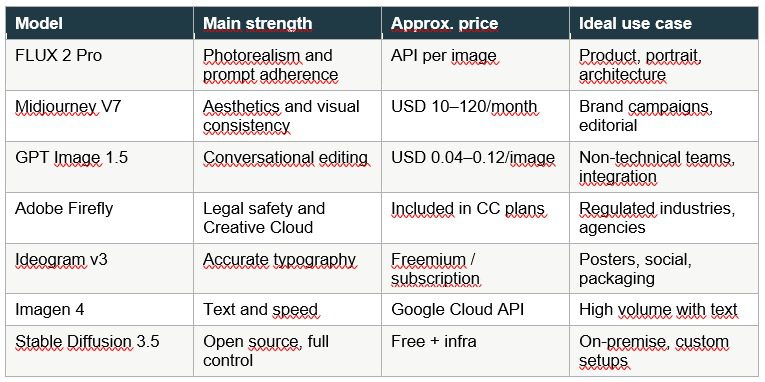
Decision criteria: realism, aesthetics, text, legal safety, budget
The decision is not about picking “the best” model — no single option leads across all dimensions. Five criteria should be weighed for each project: required level of photorealism — FLUX 2 Pro or Imagen 4 Ultra — distinctive aesthetic — Midjourney V7 — presence of text in the image — Ideogram v3 or Imagen 4 — acceptable legal risk — Adobe Firefly and FLUX.1 Schnell on the safer side — and available budget.
In our Smart Team experience, most B2B projects are not solved with a single model but with a combination: Firefly for commercially sensitive pieces, Midjourney for concepting and moodboards, Ideogram for visuals with text, GPT Image 1.5 for fast iteration with clients and Stable Diffusion when extreme customization is required. A hybrid stack typically outperforms a monolithic bet.
Visual AI becomes a competitive advantage in B2B
AI image generation has graduated from promise to creative infrastructure. Current models solve problems that looked far away two years ago: convincing photorealism, accurate typography, consistency across pieces and legal safety of content. Prices, too, have democratized to the point where any company can adopt these tools without prohibitive investment.
The relevant question for a B2B team is no longer whether to use visual AI, but how to orchestrate it inside a professional workflow that blends proprietary models, open source, human review and brand judgment. Teams that master this combination will cut production time, expand creative capacity and — above all — propose ideas that previously fell outside the budget.
At Smart Team we help companies navigate this transition by embedding visual AI inside established design and communications processes. If your organization is evaluating how to make the leap, you can read more about our approach on the Smart Team graphic design service page, where we combine human judgment and AI tooling to deliver measurable results.

Politóloga con experiencia en consultoría, comunicación corporativa y dirección de proyectos públicos y privados. Especialista en estrategia, marketing digital y transformación organizativa. Enfocada en la innovación y en la creación de narrativas que conectan tecnologías, personas y organizaciones.
Schedule a 30-minute meeting
Want to know how we can generate more leads for your business in Barcelona?
Leave us your email and phone number and we’ll schedule a no-obligation call to give you a personalized assessment of your current marketing strategy.