Sales teams love to talk about “the buyer journey” as if they’ve seen it. They haven’t.
By the time a prospect books a call, they’ve already done most of the work: they’ve named the problem, argued about it internally, shortlisted three vendors, and built a rough business case. Sales walks in for the last 20%.
Here’s the number that made me rethink how I plan content: according to Dreamdata, B2B buyers spend 80% of a 272-day buying journey researching and exploring options before they engage with sales.
Read that again. 80%.
So, if most of the B2B buying journey happens somewhere sales can’t see, the obvious question is: who’s shaping it? And the uncomfortable answer, for a lot of companies, is nobody—because the content that exists was built for a different job entirely.
What Is the “Invisible” B2B Buying Journey?
The invisible buying journey is everything a buyer does to educate themselves before a vendor conversation starts: searching, reading, comparing, asking peers, lurking in communities, running things past ChatGPT, and forwarding a case study to a colleague who forwards it to their VP.
None of it shows up in a CRM. None of it gets logged as an “activity.” But it’s where the buyer decides what “good” looks like, which vendors even make the shortlist, and what questions they’ll ask when the sales call finally happens.
I think of it less as a funnel and more as a slow, distributed group project—the buyer, plus everyone they loop in, quietly building consensus over months, mostly without you in the room.
Why Buyers Delay Talking to Sales
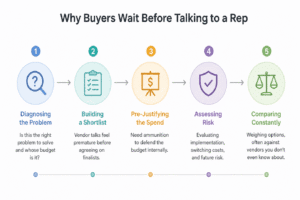
Ask any buyer why they wait so long to talk to a rep, and the answer is rarely “I wasn’t interested.” Usually, they’re still diagnosing the problem—not “which tool,” but “is this even the right problem to solve, and whose budget does it come out of?” Until that’s settled, a vendor conversation is an answer to a question nobody has asked yet.
Then comes the shortlist. Buyers want three finalists before they sit through five demos, so vendor conversations that arrive before the shortlist exists just feel premature. Running alongside that is the budget work: someone has to walk into a Tuesday leadership meeting and defend this spend, and they want ammunition before they want a rep.
The quiet one is risk. Implementation pain, switching costs, what happens if this vendor gets acquired next year—none of it gets raised on a first call, but all of it gets researched. And underneath everything, they’re comparing constantly, often against vendors you don’t even know are in the room.
Sales gets looped in once most of that is resolved. Which means that if your content strategy only kicks in at “demo requested,” you’ve missed the months in which the decision was actually made.
The Problem with Content Built Only for Lead Capture
Here’s the pattern I keep running into: a gated PDF that restates the homepage, a thought-leadership post that’s really a product pitch in a trench coat, and a nurture sequence that assumes the reader is already sold and just needs a nudge to book a call.
None of that content answers the questions a buyer is actually sitting with at month three of a nine-month journey. It’s built to capture a lead, not to help someone think.
The tell is simple: if you removed your logo from the piece, would a buyer notice it was written by a vendor with something to sell? If the answer is no—if it’s genuinely useful with the branding stripped out—you’re probably on the right track. If the answer is yes, it’s lead-gen content wearing an educational costume, and buyers are good at spotting the difference now.
7 Content Types That Influence Buyers Before the Demo
These are the formats I’ve seen actually work during the invisible 80%—not because they’re clever, but because they match a specific moment in the buyer’s head.
- Problem education content. Written for someone who hasn’t decided this is worth solving yet. No product mentions. Just: here’s why this problem is bigger, costlier, and riskier than it looks.
- Comparison guides. Buyers are comparing whether you write the comparison or not. Better that you frame the criteria than let a competitor or a mediocre third-party listicle do it for you.
- ROI explainers. Not a generic “calculate your ROI” calculator that nobody trusts, but a walked-through model: here’s what this typically costs, here’s what it typically returns, and here’s the math a CFO can poke holes in and still come away convinced.
- Implementation-reality content. What actually goes wrong during rollout, how long it really takes, and what “day 30” looks like. Buyers doing risk assessment want the boring, honest version—not the highlight reel.
- Stakeholder-specific content. A CFO reads differently than a sales leader. More on this below.
- Objection-handling articles. Take the top five things prospects push back on in sales calls and answer them in public, before the call happens. If your reps hear the same objection every week, that’s a content brief, not just a talk track.
- Proof-led use cases. Not “customer success stories” as a marketing genre, but specific, numbers-attached accounts of what changed, for a buyer who looks a lot like the reader.
How to Build Content for Every Hidden Buying Moment
Map content to the moment, not just to the funnel-stage label. A mature B2B marketing strategy starts here: a problem-aware buyer needs education content, industry benchmark data, and “is this actually a priority” framing. A solution-aware buyer wants category explainers, build-vs-buy content, and criteria-setting guides. A vendor-aware buyer is already comparing, so they need comparison pages, analyst-style breakdowns, and differentiation content.
Then the journey stops being about them. At the internal-consensus stage, the buyer needs shareable one-pagers, internal-champion decks, and ROI models built to be forwarded. At final validation, it’s implementation guides, security and compliance detail, and references and proof.
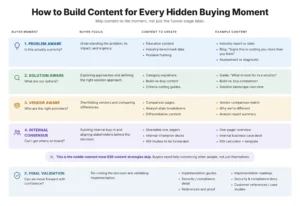
Those last two stages are the ones most B2B content strategies skip entirely, because they’re not “top of funnel” and they’re not “bottom of funnel” in the classic sense. They’re the middle, where a buyer is trying to convince other people, not just themselves.
Here’s what that looks like, stakeholder by stakeholder. A CFO doesn’t want a feature walkthrough. They want the ROI model and the risk assessment: what this costs if it goes right, and what it costs if it goes wrong. A sales leader wants proof of speed to pipeline and rep adoption: will their team actually use this, and how fast?
A marketing-ops leader wants the unglamorous detail: CRM integration, attribution logic, and how this plugs into what already exists. And the internal champion—the person actually pushing the deal forward—needs something to bring to the meeting you’re not in: a comparison page, an objection-handling one-pager, a deck they can present as their own thinking.
If your content library only has one asset per topic, it’s probably written for the champion and silent on the other three. That’s usually the gap.
Where Sales Should Feed the Content Strategy
Sales can’t see the 80%, but they hear the aftershocks of it in every call. That’s the input marketing is usually not using.
Start with call recordings, which surface the exact phrasing buyers use for problems—often not the phrasing in your content. Lost-deal notes are even more direct: a running list of objections that nobody has written an article to pre-empt. CRM data shows which content, if any, a deal touched before it closed or died. And customer-success insights show what buyers were worried about that turned out not to matter, which is great fodder for risk-reduction content.
The simplest version of this loop: once a quarter, pull the ten most common objections from lost-deal notes and check whether a piece of content answers each one, in public, before a rep has to answer it live. If it doesn’t exist, that’s next quarter’s content calendar.
Metrics That Show Whether Your Content Is Shaping Demand
The honest answer is that most of this influence won’t show up as a form fill. You’re looking for signals of shaping, not signals of capture.
The first group is behavioural. Assisted pipeline tells you which deals touched content somewhere in the journey, even when it wasn’t the last click. Return visitors on non-gated content matter more than they look: someone coming back to the same problem-education page three times over two months looks a lot like slow internal consensus-building. Engaged accounts in your ABM or intent data count too, even pre-MQL, and content paths show which sequences of pages precede a sales-accepted opportunity.
The second group is directional. Cut sales-accepted opportunities by the content the account consumed beforehand. Watch branded search lift, because more people searching your company name is a decent proxy for “we made the shortlist.” And attribute influenced revenue loosely rather than by last touch, since last-touch attribution will always credit the demo request and nothing before it.
None of these are as clean as a form-conversion rate. That’s kind of the point: if you could measure the invisible 80% as cleanly as the visible 20%, it wouldn’t be invisible.
Sales will always own the last conversation. But the seven months before it—the bulk of a 272-day decision—belong to whatever the buyer reads, forwards, and quietly builds consensus around, with or without your help.
Build the content for that stretch, and by the time sales does get the call, you’re not starting the pitch. You’re finishing one that’s already three-quarters made.

Kallis Amos
Me apasiona crear contenido que informe, conecte con el público y genere resultados. Cuento con experiencia en marketing digital, marketing en redes sociales y estrategia de contenidos, y he creado contenido atractivo para marcas en diversas plataformas. Me centro en combinar la creatividad con análisis de datos para fomentar una interacción significativa con la audiencia e impulsar el crecimiento empresarial.
Schedule a 30-minute meeting
Want to know how we can generate more leads for your business in Barcelona?
Leave us your email and phone number and we’ll schedule a no-obligation call to give you a personalized assessment of your current marketing strategy.