
The Transformation Paradox
On 5 May 2026, Microsoft published the Work Trend Index 2026, its sixth annual report on the state of work with artificial intelligence. The study combines the analysis of trillions of productivity signals from Microsoft 365 with surveys of 20,000 workers already using AI across 10 countries.
The report’s central observation captures the current state of the sector well: in many cases, employees are ready. The systems surrounding them are not. This gap between individual capability and organisational maturity is what the report calls the Transformation Paradox: the same forces accelerating AI adoption are simultaneously slowing it down.
Key Findings and Data
The report structures its findings around three levels of analysis: employees, leaders, and the organisation. The quantitative data underpinning the central argument is precise and, in some cases, unexpected.
- 58% of AI users report producing work they would not have been able to do a year ago. Among Frontier Professionals — the top 16% of users — this figure rises to 80%. This group designs multi-agent workflows, sets quality standards for AI-assisted work, and systematically shares learning across their teams.
- Only 19% of AI users work in the so-called Frontier Zone, where individual capability and organisational maturity reinforce each other. 50% sit in an intermediate emerging zone, and 10% are in a state of blocked agency: workers with advanced skills trapped in organisations that have not updated their systems.
- 65% of AI users fear falling behind if they do not adapt their way of working, but 45% admit it feels safer to focus on current objectives. Only 13% say their organisation explicitly rewards reinventing work with AI.
- Active agents in the Microsoft 365 ecosystem have grown 15 times year-on-year, reaching 18 times at large enterprises. This signals that agent infrastructure has moved from experimental to operational at a significant proportion of companies.
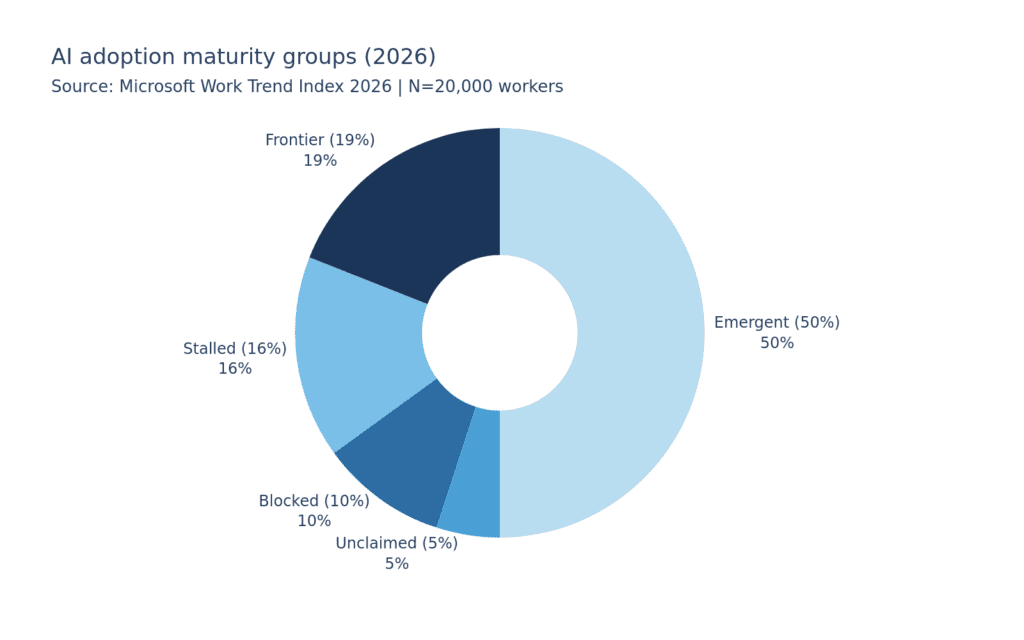
Chart 1 — AI adoption maturity groups. Source: Microsoft Work Trend Index 2026
What Changes for Organisations
The Variable That Matters Most Is Not Individual
The most management-relevant finding in the report is the distribution of AI impact between organisational and individual factors. The analysis — based on 29 variables tested with random forest models and elastic net regression across 19,854 respondents — concludes that organisational factors (culture, manager support, talent practices) explain more than twice the reported impact of individual factors: 67% versus 32%.
An organisation directing resources primarily towards individual AI tool training is addressing the factor with the lower relative weight. The return on that investment will, by definition, be limited if the organisational environment does not keep pace. The report identifies three high-leverage intervention vectors: AI-oriented organisational culture, explicit manager support, and talent practices that incorporate AI as a professional development dimension.
The Manager as a Transmission Variable
A complementary study by Microsoft’s People Science team, covering 1,800 global workers, quantifies the manager effect with precision. When managers actively model AI use, employees report a 17-point improvement in perceived AI value, 22 additional points in critical thinking about its use, and 30 points in confidence towards agentic AI. When managers create psychological safety for experimentation, employees report up to 20 more points of readiness and are 1.4 times more likely to be frequent agentic AI users.
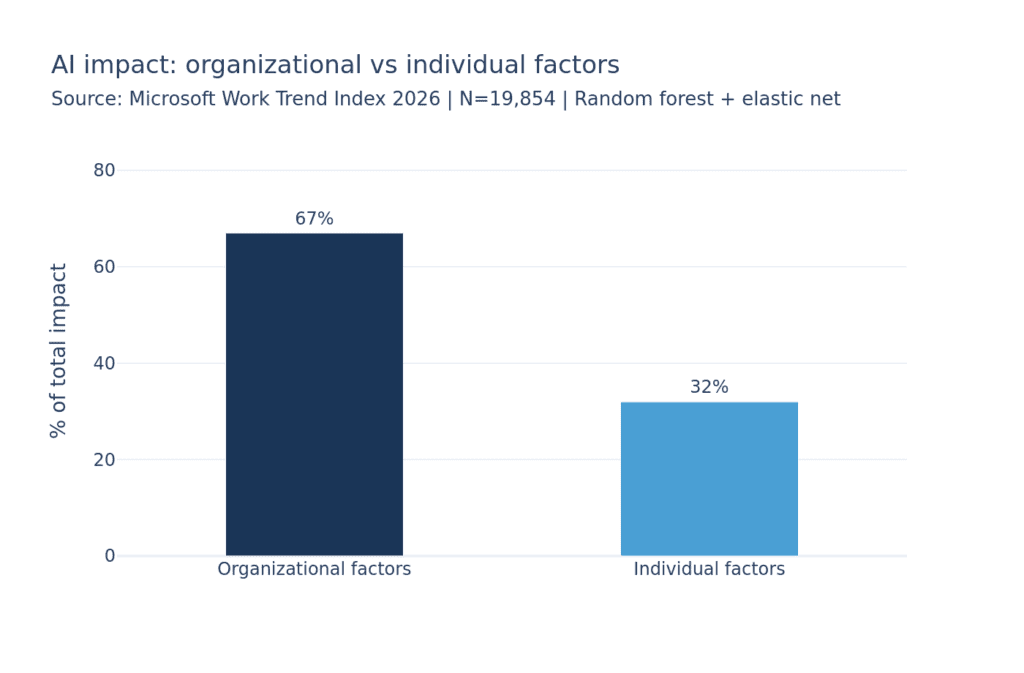
Chart 2 — Organisational (67%) vs individual (32%) factors. Source: Microsoft Work Trend Index 2026
Context and Comparative Perspective
The Work Trend Index does not arrive in a vacuum. It is published in a context where several first-tier sources have documented the same tension between technological capability and organisational absorption over recent months.
The BCG Henderson Institute published in March 2026 an analysis of 165 million jobs in the United States concluding that between 50% and 55% will be significantly redesigned by AI in the next two to three years, but that direct substitution will affect only 12%. The massive transformation of roles does not imply massive job disappearance, but rather an accelerated redefinition of the competencies required to perform them.
The Wharton AI and the Future of Work Conference, held on 20 and 21 May 2026, converges on the same diagnosis: the debate has shifted from whether AI transforms work to how organisations must redesign their systems so that transformation generates value rather than friction.
Some key ideas
- Organisational position diagnosis. The readiness index proposed by the Work Trend Index — crossing individual capability with organisational maturity — is a useful diagnostic tool. Identifying which zone teams occupy enables prioritisation of which intervention has the greatest impact.
- Redesigning the manager role in the AI equation. The complementary study data is robust enough to justify specific manager training programmes focused on facilitating AI use.
- Building agent evaluation infrastructure. As agents execute work at scale, the risk of errors propagating also scales. Organisations must define who reviews agent performance and how local learning is captured and distributed institutionally.
- For companies operating outsourced digital marketing and process models, the emergence of agents directly redesigns delegated processes: content generation, customer service, and data analysis are the areas with the greatest near-term exposure.
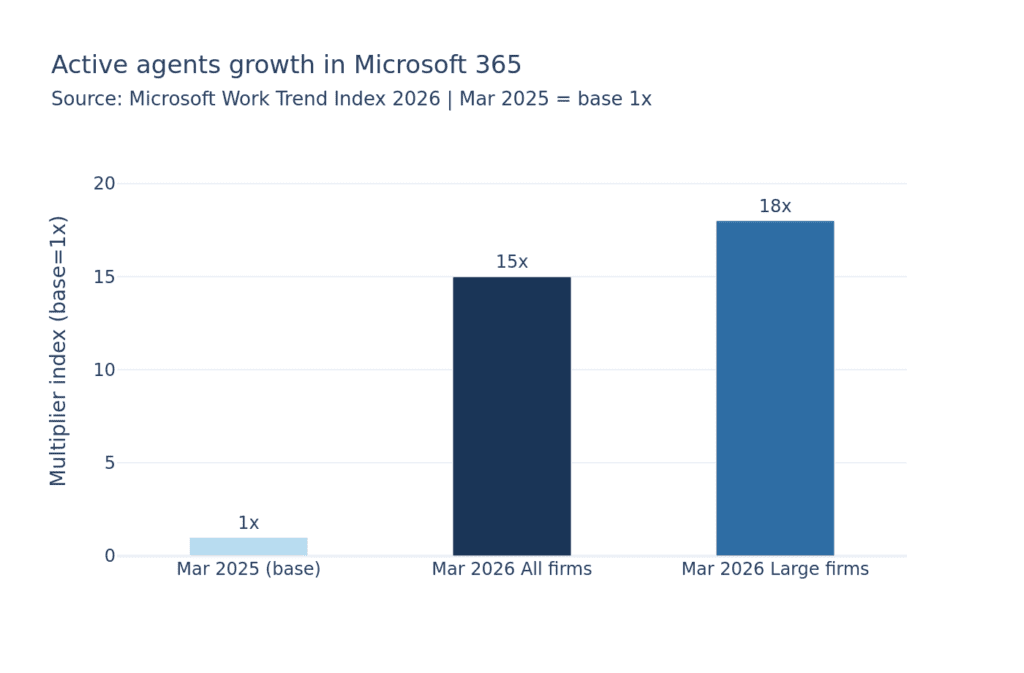
Chart 3 — Active agents growth ×15 YoY. Source: Microsoft Work Trend Index 2026
The Work Trend Index 2026 documents with quantitative precision a hypothesis many executives already intuited: the bottleneck for AI adoption lies not in technology nor in individuals, but in the organisational systems surrounding people. 67% of real-world impact depends on factors within management’s control — culture, managers, talent practices — and not on tools or individual skills.
Capturing AI value requires redesigning the organisation, not just deploying tools. The companies already doing this — those the report calls Frontier Firms — are accumulating an advantage that compounds with every learning cycle.

Emprendedor y profesional con experiencia en sectores como las agencias digitales, la comunicación corporativa, la industria musical y las administraciones públicas. Especialista en organizaciones y desarrollo de negocio. Enfocado en la comprensión y el uso de las tecnologías digitales.