A change is quietly taking place across many Spanish industrial companies. The sales manager asks for a landing page for an industry trade show, and it is ready in two hours. The operations team needs an application to manage supplier order tracking, and someone builds it over a weekend without calling a software vendor. The marketing director launches an email sequence for a new customer segment, and the HTML is written, laid out, and ready to send before the wrap-up meeting.
This is not fiction, nor is it happening only at Silicon Valley technology companies. It is happening at industrial SMEs in Bilbao, Valencia, Barcelona, and Zaragoza. And it has a name: Vibe Coding and Vibe Marketing.
This article explains what they are, how they differ, what they can specifically do for a company like yours, what real risks exist when they are used without judgment, and what the right model is for making the most of these methodologies with measurable commercial results without compromising security or regulatory compliance.
What is Vibe Coding: from an idea to software in natural language
The origin of the concept: Andrej Karpathy and the 2025 Word of the Year
The term was coined in February 2025 by Andrej Karpathy, co-founder of OpenAI and one of the world’s most influential artificial intelligence researchers. He defined it in a deliberately relaxed way: a programming style in which the developer “fully gives in to the vibes, embraces the exponentials, and forgets that the code even exists.”
Behind the informality of the language lies a technically precise idea: instead of writing code line by line, you describe in natural language what you want the software to do, and an AI tool generates functional code for you. If something does not work as expected, you describe the issue. The AI fixes it. You never need to read the code. You only define the intent and validate the outcome.
Collins Dictionary named “Vibe Coding” its Word of the Year for 2025. Searches for the term grew 6,700% between February and June of that year. In 2026, 41% of the code written worldwide is already generated by AI, and 84% of developers use or plan to use tools of this kind. This is not an emerging trend: it is the new normal in software development.
How it works in practice: describe, generate, test, iterate
The Vibe Coding work cycle has four steps that anyone can carry out, with or without technical training:
Describe. You write in natural language what you want to build. There is no need to know how to program: “I want an application that lets my sales team log customer visits, add notes, and mark the status of each opportunity” is a perfectly valid prompt.
Generate. The AI tool interprets the instruction and produces the application code: screens, database, business logic, and, in many cases, deployment infrastructure.
Test. You run what was generated and check whether it meets the requirements. This stage is critical and requires human judgment: the AI may have interpreted the instruction literally, but not exactly as needed.
Iterate. If something is not right, you describe the issue in natural language. “The registration form does not save notes when I click save” is enough for the AI to correct the error. The cycle repeats until the desired result is achieved.
What used to require weeks of engineering work can begin to be validated in days. That substantially changes the economics of technology experimentation for an industrial SME.
The key difference from traditional No-Code —platforms such as Bubble or Webflow— is that Vibe Coding generates real, portable code. You do not depend on the platform provider still existing tomorrow, you do not face functionality limits imposed by the visual interface, and if the project grows or needs specialized maintenance, the code can be handed over to a developer.
What is Vibe Marketing: creating campaigns, content, and funnels with AI without a ten-person team
Where the term comes from and why it grew 686% in one year
Vibe Marketing was born from a conversation. Greg Isenberg, CEO of LateCheckout and former TikTok and Reddit advisor, heard about Karpathy’s Vibe Coding and told a colleague: “Call it Vibe Marketing. Like Vibe Coding, but for marketing.” The idea went viral.
The concept captures something many marketing professionals were already doing intuitively but had not named: using AI tools to execute in hours what once required weeks of coordination between copywriters, designers, developers, and media buyers. According to Exploding Topics, searches for the term grew 686% over the last twelve months.
What Vibe Marketing can do in practice for an industrial company
Vibe Marketing is not using ChatGPT to write an email. It is a work methodology that integrates several AI tools into a coordinated flow covering everything from strategy to execution:
Commercial content generation. Blog articles, product sheets, technical presentations, success stories, video scripts. AI works from a strategic brief defined by a human expert and produces the first draft in minutes.
Landing page creation. A lead-capture page for an industry trade show, a product page for a new manufacturing line, or a contact page for a specific customer segment. With tools such as Lovable or Bolt, the move from brief to published page can be measured in hours.
HTML for email marketing. Nurturing sequences for long sales cycles, technical newsletters for distributors, and post-sales follow-up communications. AI generates HTML compatible with major email clients in a fraction of the time required for manual layout.
Workflow automation. With tools such as Make or n8n, lead capture, qualification, and follow-up workflows are automated by connecting forms, CRM, email platforms, and analytics tools, without code.
A single marketing professional with the right tools can execute what previously required a team of more than ten specialists.
Vibe Marketing vs. traditional agency marketing: the real difference in time and cost
The traditional industrial marketing model operates in long cycles: brief → agency proposal → revisions → production → approval → publication. Each cycle can take weeks. Each revision restarts the clock.
The Vibe Marketing model reverses that logic: execution is fast and inexpensive; strategy and supervision are where human value resides. The result is that teams can test more ideas, learn faster, and scale what works without depending on production budgets that erode margin before the first lead arrives.
For an industrial SME in Spain with a marketing team of two or three people, this is not a marginal productivity improvement: it is a complete reconfiguration of what that team can do.
Real opportunities for industrial B2B companies in Spain
Tailored internal applications: solving your own problems without relying on an external provider
Every industrial company has processes that no standard software solves exactly. A non-conformance log using the specific format of its own quality system. A manufacturing cost calculator that incorporates material variables from an internal catalog. A dashboard that combines production data with the sales team’s commercial targets.
Until recently, building these tools required hiring a developer, defining a project, waiting months, and paying tens of thousands of euros. With Vibe Coding, an operations manager with a clear understanding of what is needed can describe the tool and obtain a functional prototype in days.
In the article Vibe Coding for work teams: how to create tailored internal applications, we explore specific use cases, the most suitable tools for the industrial sector, and the most common mistakes to avoid.
Product websites and landing pages: production speed without sacrificing rankings
An industrial company’s digital presence rarely grows at the pace the business needs. A new product takes months to get its own page. A landing page for an international trade show is sometimes never even created. The result is that commercial effort has no digital support.
With Vibe Coding, the production of web pages and landing pages can be accelerated substantially. But there are important technical nuances: AI-generated code needs review to comply with the technical SEO, Core Web Vitals, and accessibility standards that determine whether that page contributes to or harms the domain’s rankings.
In the article Vibe Coding for B2B websites and landing pages, we analyze what works well, what needs expert supervision, and how to integrate AI production into a workflow that ensures technical quality.
AI-generated email marketing HTML: personalization at scale in long sales cycles
Email remains the most efficient nurturing channel in industrial B2B sales. But email HTML has technical requirements that most people do not know about: Outlook compatibility, mobile rendering, image weight, and accessibility. AI can generate HTML in minutes, but that HTML must be validated before it is sent to a contact database of customers or prospects.
In the article Vibe Coding for HTML email marketing in B2B, we detail the right workflow, the most reliable tools, and the compatibility problems that emerge if the code is not reviewed before sending.
Campaigns and commercial content: from brief to published asset in hours
For an industrial company that needs to generate technical content consistently —product sheets, industry-authority articles, presentations for distributors, customer success stories— Vibe Marketing offers a genuine acceleration of the production process.
In the article Vibe Marketing for industrial B2B companies, we develop the complete flow, from strategic brief through publication, with tools specifically suited to the Spanish industrial context.
The tools making all of this possible in 2026

Vibe Marketing tools for the industrial B2B context
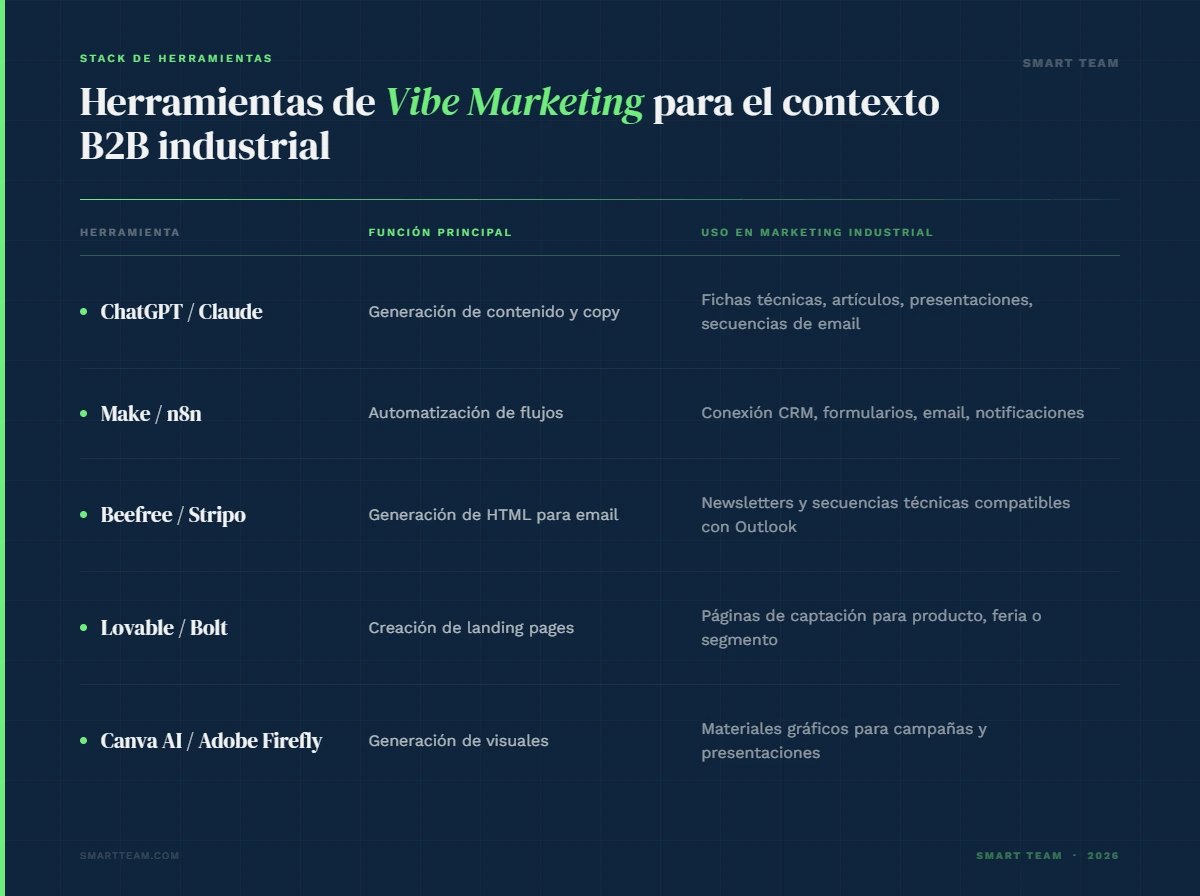
The risks no one explains before you decide to adopt these methodologies
This is where most articles about Vibe Coding and Vibe Marketing fall short. They talk about speed, democratization, and small teams competing with large companies. All of that is real. But there are specific, measurable risks with serious legal and economic consequences that any company director in Spain needs to understand before making a decision.
Security and corporate data: the figure that should concern every company in Spain
In May 2026, a RedAccess audit scanned the internet and found approximately 380,000 publicly accessible applications built with Vibe Coding tools. Around 5,000 were leaking data at that time: customer records, commercial strategies, internal conversations, and project assignments.
The problem is not only technical. Privacy settings on several Vibe Coding platforms make applications publicly accessible by default unless users manually configure them as private. Many of those applications can be indexed by Google. Anyone can find them with a simple search.
In Spain, where the GDPR is enforced with increasing rigor, this is not only a reputational issue: it creates exposure to penalties of up to 4% of the company’s global turnover. And the average cost of a security breach in Europe already exceeds $4.63 million, according to 2025–2026 cybersecurity reports.
The figure that should carry the most weight in any discussion of Vibe Coding in Spain is this: 77% of employees use ChatGPT with confidential company data without controls. That means the risk already exists in most organizations, with or without a formal AI adoption strategy.
Technical debt: the app that works today can become tomorrow’s problem
According to the 2025 Veracode GenAI Code Security Report, 45% of AI-generated code contains security flaws. Projects built exclusively with Vibe Coding accumulate technical debt at a significantly higher rate than traditionally developed projects, especially in areas such as error handling, data validation, and architectural consistency.
Salesforce identified this as one of the top three challenges for enterprise development teams in 2026: technical debt created by AI code that works in the prototype but is not ready for long-term production.
Code that “works” in a demo and code that can operate safely, scalably, and maintainably for years are different things. AI optimizes for the former. The technical expertise of a qualified team is what guarantees the latter.
GDPR and compliance: responsibilities that do not disappear because AI wrote the code
Article 30 of the GDPR requires a detailed record of all personal data processing activities. That record must be maintained by the controller: the company. Not the AI tool that generated the code.
An internal application built with Vibe Coding that processes customer, employee, or supplier data is a data processing activity. If that application does not have the right access controls, is not documented in the record of processing activities, or transfers data to servers outside the European Economic Area without appropriate safeguards, responsibility lies with the company that deployed it, not with the AI platform that generated the code.
Brand voice and commercial consistency: the risk of scaling messages without strategic judgment
In the Vibe Marketing context, the most common risk for industrial B2B companies is not technical: it is strategic. AI can generate content at volume and speed, but it has no judgment about whether that content is consistent with the company’s real value proposition, whether the technical data it includes are accurate, or whether its tone is appropriate for the decision-maker profile it targets.
A product sheet with an incorrect capacity figure. An AI-generated commercial proposal that promises a delivery timeline the production team cannot meet. A blog article that positions the company in an area management has not strategically validated. These are not minor errors in a sector where technical reputation is the most important asset.
The right model: AI as an accelerator, human experience as a guarantee of results
All the limitations and risks described above share a common solution: supervision by people with training, experience, and accountability for the outcome.
Vibe Coding and Vibe Marketing are not alternatives to expertise: they are ways to amplify what expertise makes possible. An industrial marketing specialist with ten years of experience who uses Vibe Marketing can do in five days what used to take two weeks. A qualified technical team incorporating Vibe Coding into its workflow can validate in days what previously took months to produce.
What does not work is the reverse combination: speed without judgment, volume without strategy, code without review.
What AI should decide and what a person must always decide
There are decisions AI can execute efficiently: generating a first draft of a text, producing the initial code for a feature, suggesting landing page variants, or structuring an email’s HTML. In all these tasks, AI is a speed multiplier.
There are decisions that should never be delegated to AI: positioning strategy, selecting which data can be processed in which environment, validating that technical copy is accurate, reviewing that code meets security standards before deploying it to production, and approving that a message is consistent with the company’s actual commitments.
Three first steps for an industrial company that wants to adopt these methodologies safely
First: a controlled pilot in an environment with no sensitive data. Before using Vibe Coding or Vibe Marketing with real customer data or production brand assets, test it in an isolated environment with fictional or public data. Validate what works and what does not before scaling.
Second: an audit of tools and data flows. Map which AI tools are already being used in the organization, what data are being entered into them, and whether those tools meet GDPR privacy requirements. This inventory is the starting point for an AI usage policy that protects the company.
Third: define who validates before publishing or deploying. No AI-generated content should be published without human review. No code generated through Vibe Coding should be deployed to production without a technical audit. Defining that validation process before starting production is what turns Vibe Coding and Vibe Marketing into assets rather than liabilities.
The difference of working with an expert team
There is a fundamental difference between using these tools and knowing how to use them well.
At Smart Team, we have spent years working with industrial B2B companies in Spain, integrating advanced digital marketing, SEO, GEO, and now Vibe Coding and Vibe Marketing methodologies into commercial strategies that generate measurable outcomes. We are not technology enthusiasts who recommend tools simply because they are new. We are specialists who assess each tool based on its capacity to contribute to each client’s business objectives: more qualified leads, more customers, higher revenue, and marketing and sales KPIs moving in the right direction.
When you work with Smart Team to adopt Vibe Coding or Vibe Marketing, what you get is not just access to tools: it is training, industry experience, and the accountability of a team that knows what to delegate to AI, what to review before publication, what data can enter which environment, and how to connect every marketing action to a concrete commercial result.
AI democratizes access to capabilities that once required large teams. Expert experience determines whether those capabilities become results or problems.
If you want to explore how Vibe Coding and Vibe Marketing can be integrated into your industrial company’s commercial strategy, the first step is a conversation.
Frequently asked questions about Vibe Coding and Vibe Marketing for industrial B2B companies
Do I need to know how to program to use Vibe Coding in my company? No. The most accessible Vibe Coding tools, such as Lovable or Bolt, are designed for people without technical training. You describe in natural language what you want to build, and AI generates the code. What you do need is clear judgment about what you want to achieve and the ability to assess whether the result meets the requirements. For applications that handle sensitive data or will be deployed in production, technical review by a specialist remains advisable.
How much does it cost to implement Vibe Marketing in a small industrial team? The base tools are accessible: monthly subscriptions to the leading content-generation and automation platforms range from €20 to €100 per month per tool. The real cost lies in learning time and in the strategic judgment required to obtain results. Working with a specialized external team during the initial phases of adoption is usually the most efficient option for an industrial SME.
Is it legal to use AI to generate marketing content in Spain? Yes, with nuances. AI-generated content has no general legal restrictions in Spain or the European Union. What does have legal implications is the use of personal data in prompts, advertising claims that cannot be supported by evidence, and, in certain regulated sectors, the type of information that may be communicated. A team experienced in industrial B2B marketing understands those limits.
What happens to my data if I use cloud-based Vibe Coding tools? It depends on the tool and its privacy policy. Some platforms use submitted data to train their models, which may mean confidential company information becomes incorporated into external systems. Before using any Vibe Coding tool with real customer, employee, or internal process data, you must review its terms of service and assess whether it complies with the GDPR. This is one of the most frequently overlooked points and one that can create the greatest legal exposure.
What is the difference between using Vibe Coding with an expert and doing it independently? The difference lies in the final outcome and the risk assumed. Using these tools independently can produce useful results in low-risk contexts: an internal prototype, a test page, or a test email. When the output goes into production, affects customers, or handles sensitive data, the supervision of a team with technical training, industry experience, and accountability for the outcome is not a luxury: it is what turns AI speed into sustainable commercial results.
Smart Team is a B2B marketing agency specializing in technical SEO, GEO, content strategy, and AI technology adoption for industrial and services companies. Offices in Barcelona, Madrid, and La Plata.

Consultor SEO con más de 15 años de experiencia en Marketing, optimización web y estrategias digitales. Ayudo a negocios locales, pymes y grandes empresas a mejorar su posicionamiento online, alcanzar sus objetivos de crecimiento y adaptarse a un mundo digital cada día más competitivo.
Schedule a 30-minute meeting
Want to know how we can generate more leads for your business in Barcelona?
Leave us your email and phone number and we’ll schedule a no-obligation call to give you a personalized assessment of your current marketing strategy.